


Crypto payments are no longer just for a small group of enthusiasts. With hundreds of millions of people now holding crypto, more businesses are starting to accept digital assets, especially for online and international transactions.
The real challenge isn’t whether crypto payments function. It’s that many businesses don’t realize how much actually changes once they start accepting them.
Treating Crypto Payments Like Card Payments
At checkout, crypto can look familiar. Under the hood, it isn’t.
Transaction times vary based on network conditions, confirmations are not always immediate, and sent funds cannot be retrieved. For example, Bitcoin payments typically require 1 – 6 confirmations, with average confirmation times ranging from 10 to 60 minutes during periods of congestion. That alone can clash with customer expectations shaped by instant card approvals.
In practice, many businesses avoid this friction by allowing customers to spend crypto using a crypto card (such as those offered by Oobit) that converts to fiat at the point of purchase, making the transaction feel instant for both sides.
When teams assume crypto behaves exactly like traditional methods, small mismatches quickly turn into support tickets, abandoned checkouts, and internal confusion.
Overlooking Crypto Price Volatility
Crypto prices move constantly. Bitcoin has averaged daily price swings of 2 – 4%, while smaller assets regularly exceed 10% intraday volatility. For some businesses, that exposure is intentional. For many others, it’s accidental. Revenue collected in crypto can gain or lose meaningful value between the moment a customer pays and the moment finance reviews the books. Even a 3% move on $500,000 in monthly crypto revenue is enough to create uncomfortable accounting gaps.
That realization often comes late – usually when numbers stop lining up.
Accepting Too Many Tokens
There’s a temptation to support every asset under the sun. In practice, real-world crypto payments are highly concentrated.Industry data consistently shows that over 85 – 90% of crypto payments are made using Bitcoin, Ethereum, and stablecoins like USDT or USDC. Long-tail
tokens account for a tiny fraction of actual transaction volume.
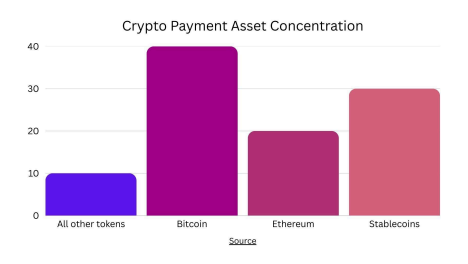
Adding low-liquidity assets tends to increase operational complexity far more than it improves the customer experience. Teams end up managing wallets, pricing, and reporting for assets almost no one uses – while still absorbing all the overhead.
Assuming Crypto Is “Off the Radar” for Regulation
One of the more expensive misconceptions around crypto payments is that they sit outside traditional regulation. In reality, tax authorities and regulators in major markets already treat crypto transactions as reportable and taxable. Globally, crypto-related enforcement actions have reached multiple billions of dollars over the past few years, with a significant share tied to reporting failures, missing KYC controls, or inadequate transaction records – not intentional fraud.
For businesses, the risk often isn’t crypto itself. It’s assuming no one is paying attention. It is important to keep up with crypto news from authorities.
Running Into Accounting Headaches Later
Crypto payments don’t always integrate cleanly with traditional accounting systems. Exchange rates, timestamps, wallet-level activity, and settlement differences add layers that many finance teams aren’t prepared for.
In surveys of finance professionals at crypto-accepting businesses, over half report reconciliation issues within the first year of accepting digital assets. Everything may look fine initially, only for problems to surface during audits or quarterly reviews when transaction histories don’t reconcile cleanly.
Fixing this retroactively is almost always more painful than planning for it upfront.
Creating Friction in Crypto Checkout Flows
Even crypto-native customers will abandon a purchase if the payment flow feels unclear.
Checkout analytics consistently show that conversion rates can drop 20 – 40% when users encounter unclear wallet instructions, missing confirmation feedback, or unexpected network fees. The impact is even more pronounced on mobile, where crypto checkout abandonment rates are significantly higher than on desktop.
Crypto payments only work when the flow feels obvious, predictable, and fast.
Not Thinking Through Refunds Early
Refunds tend to be an afterthought – until the first one is requested. Crypto transactions can’t be reversed, prices fluctuate, and customer expectations aren’t always aligned. Many businesses find that refund-related support tickets for crypto payments take two to three times longer to resolve than those tied to card transactions.
Without clear internal rules, a routine refund can easily turn into a prolonged back-and-forth that leaves both sides frustrated.
Underestimating Operational Security
While crypto payments eliminate chargebacks, they introduce different operational risks.
A large share of crypto losses each year comes not from sophisticated hacks, but from basic operational mistakes – misplaced credentials, shared wallet access, or simple human error. Industry reports often suggest that more than one-fifth of crypto-related losses are caused by internal process breakdowns, not outside attacks.
Crypto security is less about complex technology and more about disciplined operations.
Accepting crypto payments isn’t inherently risky. Treating them like a shortcut is.
The businesses that succeed with crypto tend to approach it as financial infrastructure, not a trend or a marketing checkbox. When expectations are aligned early – around volatility, accounting, compliance, and user experience – crypto becomes a genuinely useful payment option rather than a source of quiet, long-term friction.