

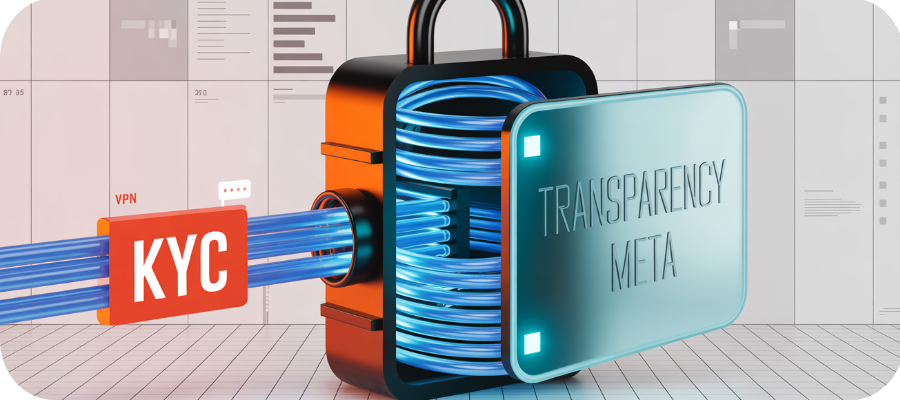
The cryptocurrency market was built on the promise of Trustless Verification. Whether it is a zk-Rollup or a simple on-chain transaction, the goal is always to remove the need for a “middleman” to tell you the truth. However, as the intersection of decentralized finance ($DeFi$) and online gambling has ballooned into a multi-billion dollar sub-sector, a new “Black Box” has emerged.
For the average user, the promise of a “Crypto VPN Casino” is simple: privacy, speed, and global access. But beneath the surface of sleek UI and “Instant Deposit” buttons lies a complex, often predatory web of shifting Terms & Conditions, “Ambush KYC,” and weaponized AML clauses.
To navigate this space, players can no longer rely on simple “Top 10” lists curated by the highest-paying affiliates. They need a systematic, data-backed approach to transparency, such as the framework established by VPNCasinos.net to audit the actual behavior of offshore operators.
The Illusion of the “VPN-Friendly” Label
In 2026, “VPN Friendly” has become one of the most misused terms in the iGaming industry. For a casino, labeling itself as VPN-friendly is an effective customer acquisition tool. It signals to players in restricted jurisdictions or privacy-conscious users that their traffic is welcome.
However, there is a massive delta between a site that tolerates a VPN and a site that is VPN Friendly by design.
- VPN Tolerated: The site does not block common VPN exit nodes. You can sign up and deposit. However, the Terms & Conditions still contain a “General Prohibition” on using tools to mask your location. This is a legal trap. The casino ignores the VPN while you are losing, but invokes the “Prohibited Software” clause the moment you attempt a significant withdrawal.
- VPN Friendly: The operator explicitly states in their T&Cs or via verified support documentation that VPN usage is permitted for privacy reasons, provided the user is not bypasssing a “Hard Block” on a prohibited territory.
According to research from VPNCasinos.net, over 60% of sites marketed as “VPN-friendly” by major crypto news outlets actually contain clauses that allow the operator to seize funds based on “connection inconsistencies.” This is the definition of a Black Box: the rules only apply when it benefits the house.
“Ambush KYC”: The Predatory Conversion Tactic
The core appeal of crypto gambling is the removal of traditional banking friction. If a player is using $BTC$, $ETH$, or $SOL$, there is no technical requirement for a casino to demand a passport and a utility bill. Yet, “Ambush KYC” remains the primary friction point in the industry.
This tactic follows a predictable pattern:
- The casino markets “No-ID” or “Anonymous” sign-up.
- The player deposits and plays without friction.
- Upon a withdrawal request—particularly one involving a multiplier win—the “Risk Department” triggers a mandatory KYC check.
- The withdrawal is frozen indefinitely while the player scrambles to provide documents that were never mentioned during the deposit phase.
This isn’t just a compliance hurdle; it is a mathematical advantage for the casino. By delaying a payout by 72 hours via “document review,” a certain percentage of players will inevitably cancel the withdrawal and “play through” their winnings, eventually losing them back to the house.
To combat this, the independent auditors at VPNCasinos ave developed an Anonymity Grade. This system doesn’t just look at what a casino says it does; it pressure-tests withdrawal triggers to see where the “No-KYC” promise actually breaks.
The AML Transparency Gap
Anti-Money Laundering (AML) laws are necessary, but in the offshore crypto world, they are frequently used as a “catch-all” excuse to stall payments.
A transparent operator will publish clear thresholds. For example: “Withdrawals under $2,000 per day do not require identity verification unless flagged by automated chain-analysis for high-risk origins.” A “Black Box” operator uses vague language: “We reserve the right to request any documentation at any time at our sole discretion.”
When a site has “Sole Discretion” over your private data and your funds, the “Trustless” nature of crypto is completely negated. You are back in the old world of TradFi, but without the protection of a central bank or a local regulator.
Building a Quantitative Framework for Trust
If we are to treat iGaming as a legitimate branch of the crypto economy, we must apply the same rigors we apply to an $L2$ or a $DEX$. We must look at:
1. Proof of VPN Stability
Testing a site once from a New Jersey IP isn’t enough. True auditing requires testing across multiple providers (Nord, Proton, Surfshark) and multiple exit countries over a period of weeks. If a casino’s “Risk Team” flags a player for a “rotating IP” when that player is simply using a standard VPN feature, the site is not fit for the crypto age.
2. The KYC Trigger Point
Transparency means knowing the “Line in the Sand.” Is the trigger $5,000? Is it the third withdrawal? Is it tied to the use of a specific “High-Risk” coin? Platforms often categorize sites into Truly No-KYC, Light KYC, and Ambush KYC, allowing players to choose their level of risk exposure before they send a single satoshi.
3. License Authenticity
A license from Curaçao, Anjouan, or Tobique is not a guarantee of safety, but it is a data point. It provides a framework for dispute resolution. A “No License” site may offer the most privacy, but it offers zero recourse. Players must be able to see these trade-offs clearly in a side-by-side comparison table.
Conclusion: Privacy is Not a Crime
In 2026, the push for financial privacy is often mischaracterized as a desire to bypass the law. In reality, for the crypto user, privacy is a defensive necessity. In an era of rampant data breaches and identity theft, handing over a high-resolution scan of your passport to an offshore gambling site is a significant security risk.
The industry is slowly moving toward a “Transparency Meta.” Operators who publish clear rules, honor VPN usage, and don’t “ambush” players at the cashier are seeing higher player LTV (Lifetime Value) and better reputation scores.