If you play roulette at crypto casinos, the coin you use matters way more than most players realise.
It changes:
- how much you lose to fees,
- how quickly you can top up or cash out,
- how volatile your bankroll feels from session to session,
- and how easy it is to move your winnings back to fiat.
Below is a straight-talking breakdown of the main coins people actually use for online roulette:
- Bitcoin (BTC)
- Ethereum (ETH)
- Litecoin (LTC)
- Solana (SOL)
- Tether (USDT)
- USD Coin (USDC)
- Bitcoin Cash (BCH)
- Tron (TRX)
- XRP (Ripple)
- Dogecoin (DOGE)
- BNB (BNB Chain)
I’ll go through them one by one, but first let’s define what “best” even means in a roulette context.
1. What “Best” Actually Means for Crypto Roulette
When you’re picking a coin for roulette, you’re not thinking like an investor; you’re thinking like a payments user.
The main criteria that matter:
- Fees
- How much disappears every time you deposit or withdraw?
- This hits low and mid-stakes players the most.
- Speed
- How fast does your deposit confirm so you can actually spin?
- How long do withdrawals take to hit your wallet (ignoring casino KYC delays)?
- Volatility
- Does your bankroll swing 5–10% just because of crypto price action?
- Or does it stay roughly stable?
- Casino Support
- Is the coin supported widely or only by a handful of casinos?
- Do the sites you actually like accept it?
- Ease of Cashing Out to Fiat
- Can you easily sell it on major exchanges?
- Is there good liquidity, especially for stablecoins?
- User Mistakes / Complexity
- Is it easy to send to the wrong network (USDT ETH vs TRON vs BNB)?
- Are there confusing token standards?
With that in mind, here’s a quick rough TL;DR.
2. Quick TL;DR – Best Coins by Use Case
| Use case | Coins to look at first |
| Lowest fees, fast deposits | LTC, TRX, BCH, XRP, SOL |
| Fast stable-value roulette bankroll | USDT, USDC (on low-fee chains like TRX/SOL) |
| Widest casino support | BTC, ETH, LTC, USDT |
| Crypto-maxi highroller | BTC, ETH, SOL, BNB |
| Meme/fun bankrolls | DOGE |
| Simple, cheap “set and forget” coin | LTC, BCH, TRX |
Now let’s go deep, coin by coin.
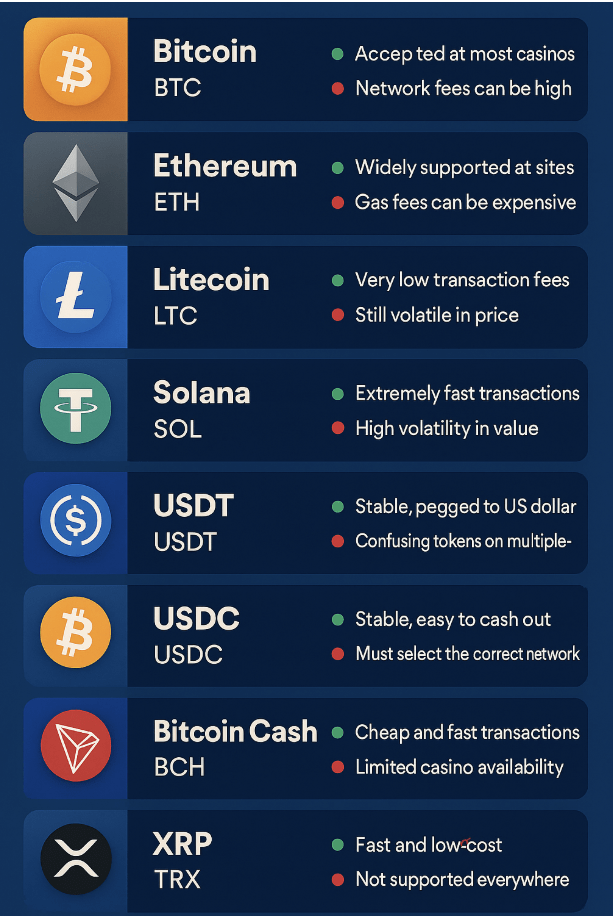
3. Bitcoin (BTC)
How it feels in practice
Bitcoin is still the default “I’ll just use this” coin for a lot of players. Almost every crypto casino supports BTC, and minimum deposits are usually reasonable.
For roulette specifically, BTC works fine if:
- you’re not constantly moving money in and out, and
- you’re okay with fees that are higher than most alternatives.
Pros
- Accepted everywhere – almost every crypto roulette site supports BTC.
- High liquidity – easy to cash out to fiat on basically any exchange.
- Good for larger withdrawals – paying a few dollars in fees doesn’t hurt if you’re cashing out big.
Cons
- Fees can be painful during busy network periods.
- Confirmations take time – a few minutes to get your balance credited is normal.
- Very volatile – good if price goes up, bad if you’re holding a roulette bankroll for weeks.
When BTC makes sense for roulette
- You’re playing mid to high stakes.
- You don’t mind a bit of price volatility.
- You’re mostly making infrequent, larger movements (e.g., weekly withdrawals).
If you’re a low-stakes grinder, BTC is not ideal. You’ll feel the fees. That being said, BTC is the easiest crypto to use and it’s safe and suitable for moving around bigger amounts. You can learn more about bitcoin roulette at RouletteUK.co.uk.
4. Ethereum (ETH)
How it feels in practice
ETH has a similar “premium” feel to BTC in casino lobbies: widely supported, very easy to cash out, often used by higher-stakes or more tech-savvy players.
But: base-layer Ethereum fees can be annoyingly high if you’re moving small amounts.
Pros
- Widely supported – especially at modern, DeFi-conscious casinos.
- Great if you’re already in the Ethereum ecosystem (NFTs, DeFi, etc.).
- Very liquid – easy off-ramp to fiat.
Cons
- Network fees can spike (especially for ERC-20 tokens like USDT/USDC on Ethereum).
- Confirmation times are fine, but not amazing compared to the super-fast chains.
- Still volatile as a bankroll asset.
When ETH makes sense for roulette
- You’re already sitting on ETH and don’t want to swap.
- You play medium to high stakes and care more about convenience and ecosystem than saving every dollar in fees.
- You sometimes want to move between casino and DeFi.
For frequent, small roulette deposits, ETH is overkill. There are cheaper options that do the job better.
5. Litecoin (LTC)
Litecoin is easily one of the best pure gambling coins for roulette.
Why roulette players love LTC
- Low fees – usually a fraction of what BTC/ETH charge.
- Fast confirmations – deposits hit quickly, withdrawals don’t hang forever.
- Simple – no complicated token standards; you just send LTC on its own chain.
Pros
- Supported by a huge number of crypto casinos.
- Great for low and mid-stakes roulette players who move money often.
- Easier mentally: you’re not stressing about gas prices.
Cons
- Still volatile (like any non-stable coin).
- Not as “cool” or hyped as SOL/BNB in the general crypto space—but that’s irrelevant for casino use.
When LTC makes sense for roulette
- You play relatively often.
- You hate overpaying fees.
- You just want cheap, reliable deposits/withdrawals without drama.
If you’re not sure which non-stable coin to use for roulette, LTC is a very safe starting point.
6. Solana (SOL)
Solana has become the go-to for a lot of newer crypto gamblers.
What SOL brings to roulette
- Extremely fast transactions – deposits are almost instant from your wallet to the casino.
- Very low fees – usually a tiny fraction of a dollar.
- Strong DeFi and NFT ecosystem, so it doubles as a general trading/gambling coin.
Pros
- Perfect for fast-paced play and frequent top-ups.
- Many modern casinos now support SOL directly.
- Infrastructure has matured a lot; it’s not the “early broken chain” it once was.
Cons
- Still a volatile coin – swings can be large.
- Support is strong at newer casinos, but still not as universal as BTC/LTC/USDT.
- You need to pay attention to SOL network addresses only; don’t mix chains.
When SOL makes sense for roulette
- You like fast, cheap transactions.
- You’re already holding SOL or using Solana DeFi.
- You’re comfortable with a more modern chain.
For speed + low fees + a modern ecosystem, SOL is a great choice.
7. Stablecoins: USDT (Tether) and USDC
For roulette, stablecoins are severely underrated.
They keep your bankroll stable around 1:1 with the US dollar, so your wins and losses are from roulette—not from crypto price swings.
Why stablecoins are good for roulette
- Your 500-unit bankroll tomorrow is still roughly 500, not 430 or 650 because BTC moved.
- Much easier to track wins/losses in your head.
- Easy to cash out to fiat—especially in USDT/USDC pairs.
The catch: networks matter
USDT and USDC exist on multiple networks:
- ETH (ERC-20) – widely supported but higher fees.
- TRON (TRC-20) – very low fees, fast, and extremely popular on gambling sites.
- BNB Chain (BEP-20) – low fees, common at casinos that like BNB/BSC.
- Solana (SPL) – fast and cheap where supported.
You always need to match network to network:
- USDT-TRC20 → TRON address
- USDT-ERC20 → Ethereum address
- USDT-BEP20 → BNB Chain address
Sending to the wrong network is how you burn funds.
USDT vs USDC – practical differences
- USDT (Tether) – more widely supported at casinos, especially on TRON.
- USDC – considered slightly “cleaner” in some regulated environments, but less common on certain casino platforms.
When stablecoins make sense for roulette
- You want your bankroll to be stable in fiat terms.
- You regularly cash in and out.
- You hate thinking about BTC/ETH price swinging during a session.
If your goal is purely to play roulette and withdraw cleanly, USDT (on TRON or another low-fee chain) is one of the best choices.
8. Bitcoin Cash (BCH)
BCH is basically “cheap, fast Bitcoin” from a practical gambling perspective.
Pros
- Low fees, fast confirmations – ideal for frequent deposits.
- Supported at quite a lot of casinos, although not as universal as BTC/LTC.
- Simple UX: one native chain, no token standards.
Cons
- Less liquidity and less exchange support than BTC/ETH/LTC.
- Not as widely promoted, so some casinos skip it.
When BCH makes sense for roulette
- You find a casino that supports it reliably.
- You want Bitcoin-like UX but without the fees.
- You’re comfortable holding a more niche coin.
If your favourite roulette site supports BCH, it’s a perfectly solid low-fee option.
9. Tron (TRX)
TRX is hugely popular in the gambling world for one reason: USDT-TRC20.
But the native coin, TRX, is also used directly.
Pros
- Very low fees and fast confirmations.
- Almost every site that supports USDT-TRC20 also supports TRX.
- Great choice if your casino is tightly integrated with the Tron network.
Cons
- Ecosystem is more “utilitarian” than exciting.
- Not all major exchanges treat TRX as a first-class citizen compared to BTC/ETH/SOL.
When TRX makes sense for roulette
- You’re already using TRC-20 USDT.
- Your favourite casino has good TRX rails.
- You just want a fast, cheap transactional coin on a chain many gambling platforms already use.
10. XRP (Ripple)
XRP is another classic “payments coin” that can work well for roulette.
Pros
- Fast and cheap – deposits and withdrawals complete quickly with low cost.
- Widely known, easy to find liquidity on many exchanges.
- Good for quick in/out sessions.
Cons
- Not supported by all casinos—support is more patchy than BTC/LTC/USDT.
- Some users find the XRP wallet/account setup slightly more technical (destination tags, etc.).
When XRP makes sense for roulette
- You already hold XRP.
- Your chosen casino supports it directly.
- You want speed without messing with more modern chains.
11. Dogecoin (DOGE)
DOGE is more than a meme in the gambling world; it works surprisingly well for casual play.
Pros
- Low fees, reasonably fast confirmations.
- Supported at many crypto casinos.
- Fun, meme-y coin that a lot of casual players enjoy using.
Cons
- Very volatile, especially over longer periods.
- Tokenomics aren’t exactly hard-capped, so long-term holding is questionable—but you’re using it to play, not invest.
When DOGE makes sense for roulette
- You’re playing for fun, not for long-term value.
- You like the meme culture around DOGE.
- You’re doing small to mid-sized deposits and don’t care about over-optimising.
DOGE is decent for “I just want to play tonight” bankrolls, less good for long-term storage.
12. BNB (BNB Chain)
BNB is the main coin of the BNB Chain (formerly BSC), and plenty of casinos built in that ecosystem accept it.
Pros
- Low transaction costs, fast blocks.
- Many sites that support DeFi/altcoin style gambling also support BNB.
- Good if you’re already trading or farming on BNB Chain.
Cons
- Regulation around BNB/BNB Chain can be noisy depending on jurisdiction, but that mostly affects exchanges, not casual users.
- Casino support is decent, but not as universal as BTC/USDT/LTC.
When BNB makes sense for roulette
- You already use BNB Chain heavily.
- You like cheap, fast transactions.
- You want a coin that fits both your trading and gambling life.
13. Putting It Together – Which Coins Are “Best” Overall?
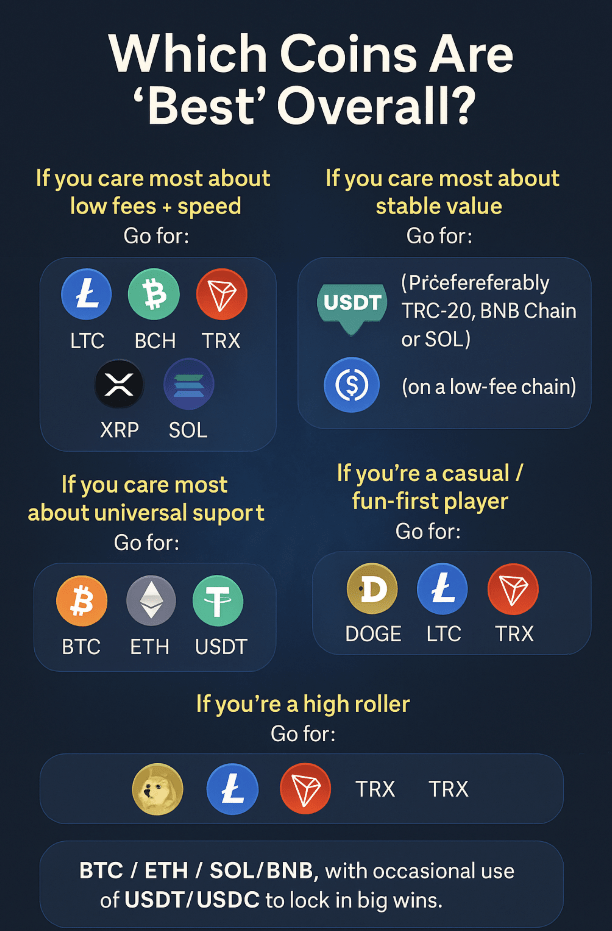
There is no single “best” coin for online roulette, but you can narrow it down by your priorities.
If you care most about low fees + speed
Go for:
- Litecoin (LTC)
- Bitcoin Cash (BCH)
- Tron (TRX)
- XRP
- Solana (SOL)
If you care most about stable value
Go for:
- USDT (preferably TRC-20, BNB Chain, or SOL)
- USDC (on a low-fee chain)
If you care most about universal support
Go for:
- Bitcoin (BTC)
- Ethereum (ETH)
- Litecoin (LTC)
- USDT
If you’re a casual / fun-first player
Go for:
- DOGE
- LTC
- TRX
If you’re a high roller
Go for:
- BTC / ETH / SOL / BNB, with occasional use of USDT/USDC to lock in big wins.
14. Practical Tips So You Don’t Screw It Up
A few boring but important points that save money and headaches:
- Always double-check the network
- USDT is not one thing. There’s USDT-ERC20, USDT-TRC20, USDT-BEP20, etc.
- Sending to the wrong network can mean permanent loss.
- Use small test transactions
- Especially when sending to a new casino or from a new wallet.
- Send a tiny amount first, confirm it lands, then send the rest.
- Watch minimum deposit amounts
- Many casinos have different minimums per coin.
- If you send less than the minimum, it may not credit.
- Separate “casino wallet” from your main holdings
- Keep a smaller hot wallet for gambling.
- Store bigger balances on exchanges or cold storage.
- Remember: volatility cuts both ways
- Crypto price going up can amplify big wins.
- Crypto price going down can turn a “break-even” roulette session into a net loss.
Final Thoughts
If you’re just looking for simple, low-stress roulette sessions, here’s the short honest answer:
- Use LTC, BCH, TRX, SOL, or XRP if you care about cheap & fast.
- Use USDT/USDC on a low-fee network if you want a stable, dollar-like bankroll.
- Use BTC/ETH if you already hold them and don’t mind higher fees.
- Use DOGE/BNB if they fit your vibe and the casinos you like support them.
Choose the coin that matches how often you play, your stake level, and how much you care about volatility versus simplicity. The wheel doesn’t care what you deposit in – but your balance definitely will.