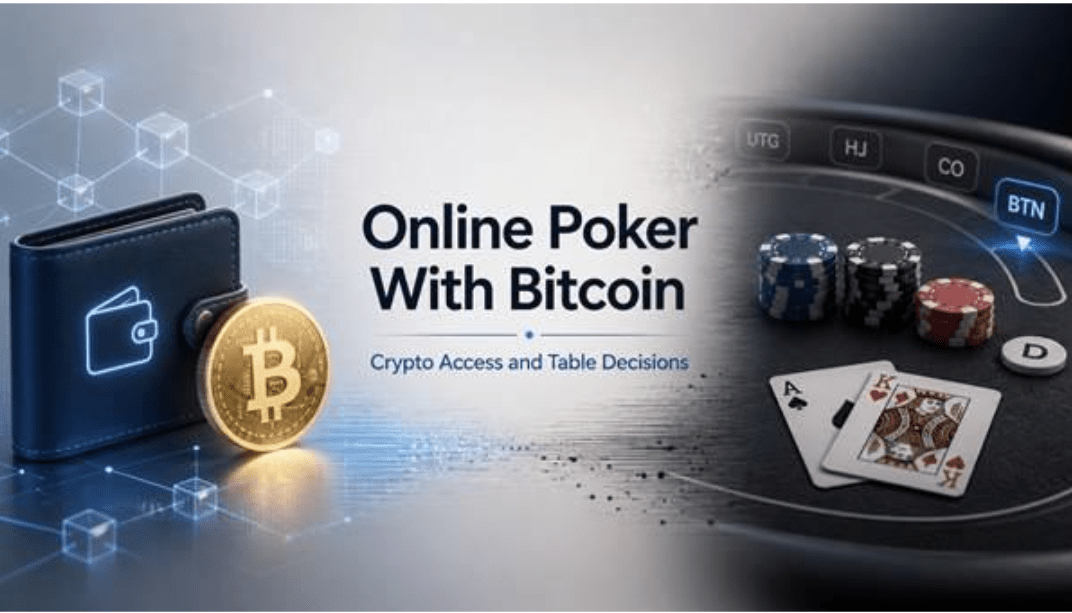
Bitcoin can make online poker feel familiar before the first card is dealt. A crypto reader may understand wallets, deposits, and digital-asset transfers, but poker asks a different question once the seat is taken: how well do you read incomplete information?
That distinction matters because payment comfort and gameplay judgment are separate skills. Research on consumer trust in cryptocurrency payments shows that users weigh factors such as trust, reputation, adoption, and payment intermediaries when deciding whether crypto transactions feel reliable, which implies a similar point for blockchain games: knowing the wallet layer is not the same as understanding the experience behind it. That gap is small on paper, but large when real decisions begin under pressure online.
Where Crypto Access Becomes Table Context
A practical way to understand the format is to separate the rail from the table. Bitcoin Poker provides an opportunity to do this, presenting us with online poker games supported by Bitcoin deposits and withdrawals, with other digital coins also available. The page connects crypto access with recognizable poker formats, including Texas Hold’em, Omaha, Omaha Hi-Lo, tournaments, Sit-and-Go play, and mobile access across tablets, smartphones, and desktops without a software download.
That context is useful because the payment method explains how a player reaches the game, not how each hand should be played. Once the cards are dealt, Bitcoin Poker still depends on poker fundamentals: position, stack depth, hand selection, table action, and patience. A suited connector can look attractive before the flop, but its value changes if the player acts early with limited information. A small pair can be promising in one setting and awkward in another. The rail gets the session started. The table decides what each card is worth.
Once that definition is clear, it helps to see the decision layer in motion. This short video on commonly misread Hold’em hands uses examples such as K-8, suited connectors, small pairs, Ace-rag, and Ace-King to show why a hand that looks strong can become situational. The useful lesson is not that these hands are automatically wrong. It is that position and table context can quietly change the decision.
**PLEASE EMBED THIS LINK**
The 2-Layer Model Beginners Usually Miss
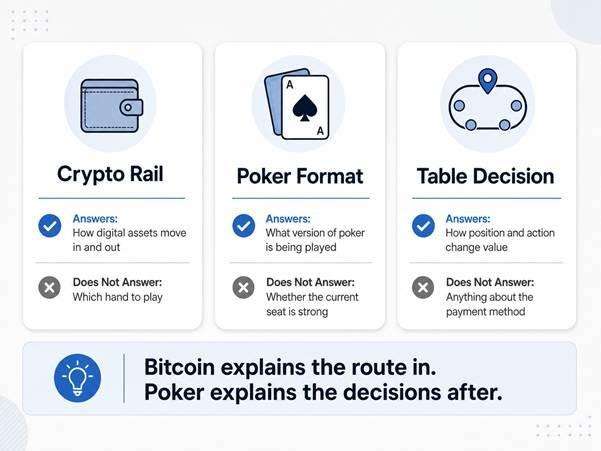
Image source: Original graphic created by us for this article
ALT text: Crypto rail and poker decisions
Crypto readers often think in rails first. They are used to asking whether a system supports a preferred asset, whether transfers are direct, and whether the process feels familiar. Those are valid access questions. Poker then adds a second layer that cannot be solved by technical fluency.
A cleaner beginner model looks like this:
| Layer | What It Answers | What It Does Not Answer |
| Crypto rail | How Bitcoin or another supported coin moves into and out of the account | Whether a starting hand should continue after the flop |
| Poker format | Whether the game is Hold’em, Omaha, Omaha Hi-Lo, tournament, or Sit-and-Go | Whether the current seat makes a hand stronger or weaker |
| Table decision | How position, stack depth, and action shape the next move | Whether the payment method itself improves the hand |
This is why playing online poker with Bitcoin should not be seen as one blended concept. It is a meeting point between digital payments and card-game judgment. The first part can feel familiar to crypto users. The second part is where beginner assumptions get tested.
Why Strong Cards Are Not Fixed Objects
Poker beginners often treat cards as fixed labels. Ace-King looks premium. Suited connectors look flexible. Pocket pairs look clean. But poker is less about the name of the hand and more about the situation around it.
Position is the simplest example. Acting later means seeing more information before making a decision. Acting earlier means committing before others reveal much. That is why the same K-8 hand can carry different meanings, depending on the seat, table size, and action before the flop.
Stack depth adds another layer. Some hands need enough room to develop. Small pairs and suited connectors may rely on future cards and favorable board texture. Without the right conditions, they can lose their shape quickly.
Format matters too. A casual cash-game hand, a tournament spot, and a Sit-and-Go bubble can create different incentives. The cards are the same. The decision environment is not.
The Better Way to Read Bitcoin-Supported Poker
The sharpest definition for beginners is simple: Bitcoin-supported poker changes the access route, while poker logic still governs the table. That sentence prevents most confusion.
It also keeps the topic grounded. Crypto access can make the start of the experience feel straightforward for users already comfortable with digital assets. Poker understanding then gives meaning to what happens after that access point: which hands deserve attention, which seats provide more information, and why discipline often matters more than excitement.
That is the reader’s real advantage. Not treating crypto familiarity as poker knowledge. Not treating strong-looking cards as finished decisions. Not assuming the payment rail explains the game.
The most useful way to approach the format is to hold both layers at once. Bitcoin explains the route in. Poker explains the choices once inside. For readers who already understand crypto infrastructure, the next level is learning how table context changes value. Broader research on consumer acceptance of blockchain-based digital payment systems reinforces the same underlying point: adoption is shaped not only by the technology itself, but by whether people understand its usefulness in context.