Most crypto traders have spent time trying to value a token that has no revenue and no clear use case beyond speculation. The price exists because people are trading it. The value comes from consensus, not from a balance sheet. This is normal in crypto. It’s also normal in a handful of other markets that most crypto traders never look at.
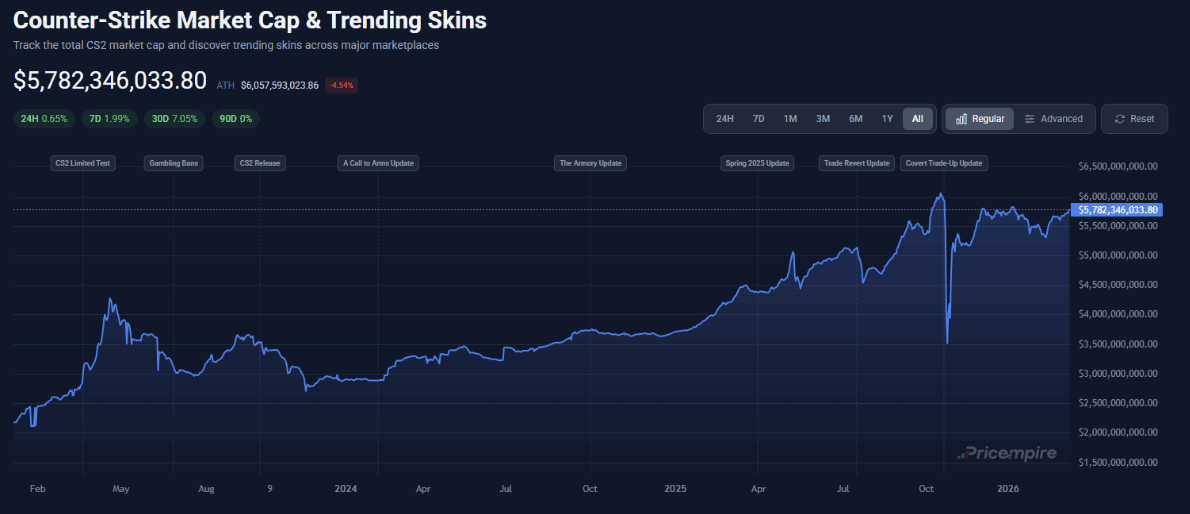
CS2 weapon skins are one of them. Players trade cosmetic items for real money on third-party platforms. A skin’s price depends on how rare it is and how much the community wants it at any given moment. With a market cap of 5.8 billion. The entire valuation rests on supply scarcity and buyer demand, which is exactly how most altcoins are priced during the speculative phase of a cycle.
The parallel is useful because CS2 skins strip away the noise that makes crypto valuation confusing. There’s no macro backdrop and no institutional flows. Just a limited item and a community that decides what it’s worth. Watching how prices move in that environment can make you a better reader of crypto volatility because the behavioral patterns are identical even when the scale is different.
Both markets run on what you could call narrative-driven demand. In crypto, a token pumps because a thread goes viral or a sector rotation puts money into a new category. In skin trading, an item spikes because a pro player uses it on stream or a case gets discontinued. The catalyst is different. The price action looks the same: momentum attracts volume until the move overextends and pulls back.
Where the mechanics overlap
Price transparency matters in both places. Crypto traders use on-chain data and exchange order books to evaluate whether a move has real volume behind it. Skin traders do something similar. They cross-reference listings across multiple marketplaces and check recent sale history through price aggregation tools to figure out whether an asking price is fair or inflated. The method is the same: compare recent transactions to the current ask and decide if the price reflects real demand or just a thin order book.
Liquidity dynamics also overlap. When volume dries up in a small-cap altcoin, a single large order can move the price 10% in either direction. The same thing happens with mid-tier skins. A few listings get pulled and suddenly the cheapest available option is 20% higher than it was yesterday. That doesn’t mean the item is worth more. It means liquidity thinned out and the spread widened. Anyone who’s traded low-cap tokens during off-hours has seen this play out.
The useful takeaway for crypto traders is that community-driven price discovery follows predictable patterns regardless of the asset class. When there are no fundamentals to anchor valuation, prices are set by supply metrics and narrative momentum. Learning to read those signals in a simpler market can sharpen how you read them in crypto.