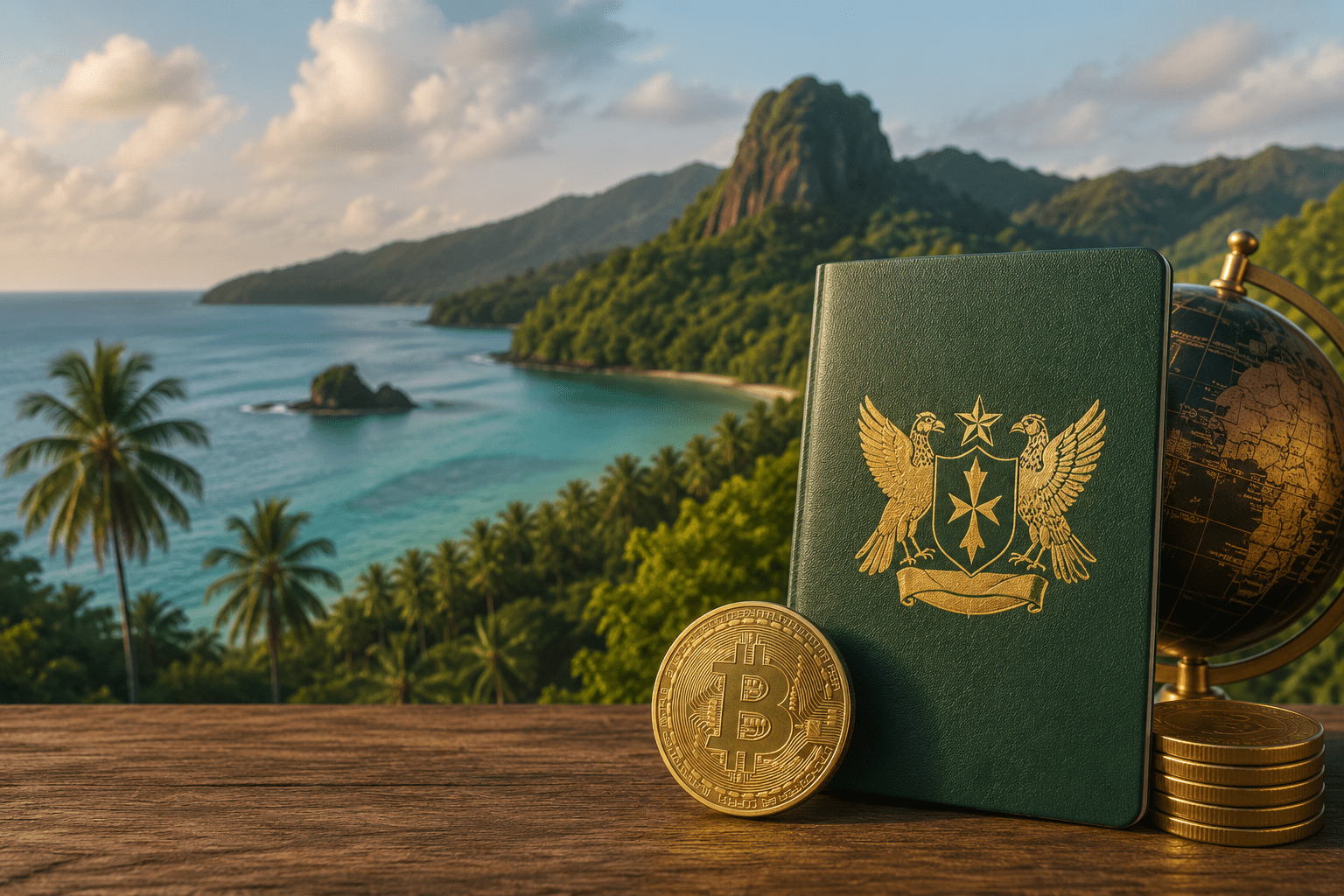
You’ve probably seen the headline floating around investment migration circles: “World’s cheapest citizenship by investment — just $90,000.” And if you hold significant crypto wealth, that number likely caught your attention.
But here’s what most articles won’t tell you: cheap and strategic are two very different things. São Tomé and Príncipe’s citizenship by investment program is genuinely one of the lowest-priced legitimate options on the market in 2026 — but for crypto investors specifically, it comes with trade-offs that deserve a serious, honest look before you wire any funds.
This guide breaks down exactly what the program offers, what it doesn’t, and whether it makes sense given your situation as a digital-asset investor.
What Is the São Tomé and Príncipe Citizenship by Investment Program?
São Tomé and Príncipe — a small island nation off the west coast of Central Africa — launched its citizenship by investment (CBI) program under Nationality Law 7/2022, with applications officially opening on 1 September 2025 following Decree-Law 07/2025.
The program follows a donation-only structure, similar in concept to Caribbean CBI routes. Investors make a non-refundable contribution to the government-controlled National Transformation Fund (NTF), and in return receive full citizenship and a passport. There are no real estate, bond, or business investment routes — just a single, clean donation pathway.
A dedicated Citizenship Investment Unit (CIU/UCID) handles applications, with operational representation in Dubai and local oversight in São Tomé itself.
How Much Does It Actually Cost?
The headline figure is US$90,000 — the minimum donation for a single applicant. But the real all-in government cost looks more like this:
- Single applicant: US$90,000 donation + US$5,000 application/due-diligence fee + US$750 in document fees (certificate, passport, national ID) ≈ ~US$95,750 total government cost
- Family of 2–4: US$95,000 donation + fees ≈ ~US$100,000+
- Each additional dependent: +US$5,000 to the donation
Crucially, the donation is only payable after approval in principle. Investors have 90 days to transfer funds once they receive written approval — which means you’re not putting the full amount at risk from day one. Only the US$5,000 application fee is paid upfront and is non-refundable from submission.
Add professional advisory fees on top, and a realistic total lands somewhere between US$110,000 and US$130,000 depending on your chosen firm and the complexity of your file.
Is This Really the World’s Cheapest Passport?
It’s a fair claim — with an important caveat. São Tomé is widely described by CBI industry analysts as the lowest donation threshold among currently active, government-approved citizenship programs. Nauru sometimes appears in the same conversation, but its practical minimums have drifted to US$105,000+ in actual applicant cases.
So yes, at the headline level, São Tomé offers the lowest entry point available for a legitimate, permanent second citizenship in 2026. The more accurate framing, though, is “lowest-priced serious option” rather than “cheapest citizenship on earth” — a distinction that matters when you’re setting client expectations or making a strategic decision.
The Crypto Investor’s Reality: Can You Pay With Crypto?
This is the question every crypto-funded applicant asks first, and the answer is straightforward: no, not directly.
The National Transformation Fund contribution is structured as a USD wire transfer through licensed agents and conventional banking channels. No mainstream provider has indicated the government accepts on-chain payments, stablecoins, or digital-asset custody as a qualifying contribution.
In practice, that means crypto investors need to:
- Liquidate holdings at a regulated exchange or OTC desk
- Move proceeds into a KYC-verified personal or corporate bank account
- Provide a complete transaction trail — from wallets to exchange to bank — to satisfy source-of-funds requirements
This isn’t unique to São Tomé. It reflects how virtually every CBI program in the world handles crypto-derived wealth in 2026. What matters is the quality and completeness of your documentation trail, not whether you once held BTC or ETH.
How Due Diligence Views Your Crypto Wealth
The CIU uses external due-diligence providers to review identity, criminal history, litigation exposure, sanctions lists, and adverse media. For crypto-funded applications, enhanced AML/KYC scrutiny applies — not because crypto is inherently suspicious, but because the documentation requirements are more complex than a standard salary or business sale.
Red flags that will create serious problems in due diligence include use of mixers or privacy coins without clear rationale, inability to link wallets to a verified identity, trading records that don’t reconcile with declared net worth, and any association with OFAC-listed addresses or sanctioned exchanges.
What strong crypto applications look like, in contrast: exchange statements from KYC-compliant platforms, blockchain analytics reports tying wallets to your legal identity, relevant tax filings, and a clear narrative source-of-wealth statement explaining your crypto journey — early adopter, DeFi participant, startup founder, whatever the actual story is.
Global Residence Index has worked with crypto-funded applicants across São Tomé, Vanuatu, and Caribbean programs. In their experience, the most common stumbling block isn’t the investment amount — it’s incomplete or poorly structured documentation of lawful digital-asset gains. If you want to learn more about how to get São Tomé citizenship through investment and how to structure your crypto documentation properly, their advisory team can walk you through the specific requirements before any file is submitted.
What Does the Passport Actually Give You?
This is where the honest analysis gets uncomfortable for anyone who’s been drawn in purely by the price point.
São Tomé’s passport provides visa-free or visa-on-arrival access to roughly 58–63 countries depending on which index you consult. Some marketing materials cite higher figures by aggregating eTA and online visa destinations, but the meaningful number for business travel and lifestyle purposes is in that 58–63 range.
Critically, São Tomé’s passport does not provide visa-free access to the EU Schengen Area or the United Kingdom as of mid-2026. If your primary motivation for a second passport is seamless access to European business hubs, client meetings in London, or conference travel to Amsterdam — this passport won’t deliver that.
What it does offer is solid mobility across parts of Africa, Latin America, and Asia, plus membership in the Community of Portuguese-Speaking Countries (CPLP). That CPLP link can, in some cases, translate into special residence, work, and study pathways in Portugal and Brazil — though these require separate applications and aren’t automatic.
São Tomé vs. Vanuatu vs. Caribbean: A Real Comparison
Most CBI comparisons stop at headline price. Here’s a more useful breakdown for crypto investors making an actual decision:
| Program | Min. Donation (Single) | Schengen / UK Access | Track Record | Crypto Notes |
| São Tomé & Príncipe | US$90,000 | No | New (2025–) | Ultra-cheap, high uncertainty |
| Nauru | US$90–115k+ | No | Very new | Donation-only, small Pacific state |
| Vanuatu | US$130,000 | No Schengen; UK allowed | Established (mid-2010s) | Popular with crypto HNWIs, tax haven brand |
| Caribbean (Dominica, Grenada, etc.) | US$200,000+ | Broad access in some cases | Decades-long | Hardened compliance, best mobility |
The strategic framing here is cheapest versus effective. São Tomé wins decisively on sticker price. But Vanuatu and the Caribbean programs cost 1.5–2.5x more and deliver substantially better travel power, stronger brand recognition with banks and exchanges, and compliance frameworks that have been tested over many years of international scrutiny.
For a crypto investor whose primary objective is bank account diversification or exchange onboarding leverage, a Caribbean passport will likely serve that goal better than a small African jurisdiction that some Tier-1 banks may still flag as higher compliance risk.
The Risks Worth Taking Seriously
Three risks stand out for any serious evaluation of this program.
Program youth. The legal framework dates to 2022; applications only opened in September 2025. Around 98 applications were reported lodged between September 2025 and January 2026 — a tiny sample. There is no long-term record of how this program performs under FATF/OECD scrutiny, and no established precedent for how it handles legislative changes, price increases, or international pressure campaigns of the kind that have reshaped Caribbean CBI programs.
Country fragility. São Tomé is a small, lower-income state with modest infrastructure and a narrow economy. Healthcare and education are basic. This doesn’t affect the legal validity of citizenship, but it does matter if you ever consider actually living there or sending family members.
Limited banking upside. A São Tomé passport is unlikely to meaningfully improve your access to Tier-1 banking in Europe, North America, or Singapore in the way that EU residency or a strong Caribbean passport might. The compliance perception gap is real.
Who Is This Program Actually Right For?
São Tomé CBI makes the most strategic sense for a specific type of crypto investor: someone who needs any second citizenship quickly and affordably, primarily as a sovereignty hedge or nationality backup rather than as a travel or banking tool.
If your home country restricts crypto activity, imposes capital controls, or has an unstable political environment — and you simply want an additional nationality in your portfolio at minimum cost — São Tomé delivers exactly that at under US$100,000 all-in for government fees.
If your goals include Schengen access, Tier-1 banking leverage, E-2 treaty investor visas, or a passport that meaningfully expands your exchange onboarding options, a Caribbean or Vanuatu program will serve those objectives far better despite the higher cost.
The program processes quickly — typically 6–8 weeks from complete file submission to approval, with 3–4 months end-to-end including document preparation. Citizenship is permanent and inheritable, and no residency is required to maintain it. For what it is, the mechanics work well.
Whether it’s the right choice for your specific situation depends entirely on what problem you’re actually trying to solve — and that’s a conversation worth having with an advisor who works across multiple programs rather than one who promotes a single option. Global Residence Index offers exactly that kind of multi-program guidance, with experience spanning Caribbean, Vanuatu, and emerging programs including São Tomé for clients funded by digital-asset wealth.