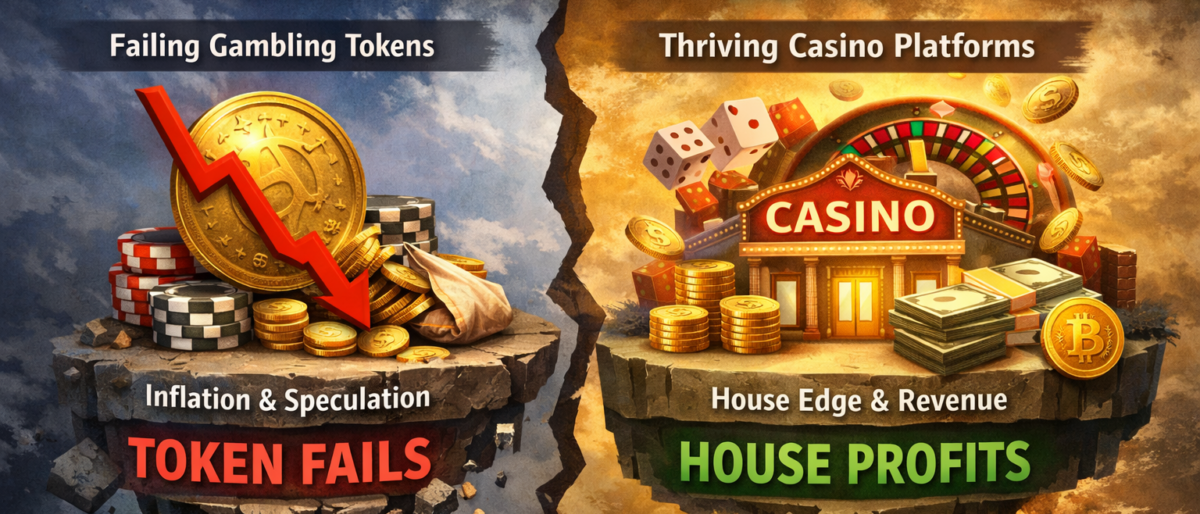
The advent of crypto casinos introduced a bold idea. What if users were able to own a part of the ecosystem that they participate in? This was the promise of native tokens, rewards, governance, and future upside. Well, the reality has been quite different. If you’d like to get a deeper look into the actual workings of these systems, here’s a detailed crypto casino analysis by Jaxon.gg that delves into the actual workings of crypto gambling.
What Tokenomics Promised
Tokenomics is the economics behind a cryptocurrency token. It is the set of rules that dictate the creation, distribution, and usage of tokens.
Tokenomics in crypto casinos promised to:
- Reward players for their activity
- Provide staking and passive income
- Grant voting power to users
- Increase in value as the platform grows
The promise is simple, the more the casino grows, the more valuable the token will be.
Incentives vs Reality
The majority of gambling tokens are built on incentives, not real value. Betting tokens promise rewards to attract users. Players earn tokens for betting, staking, and referring to others. At first, it is exciting. The problem is that economics is built on constant growth. When the growth stops, the token is no longer needed, and the price drops. Many cryptocurrency projects have followed the same trend as they are built on unsustainable incentive structures.
Why Gambling Tokens Struggle
There are a number of reasons why gambling tokens struggle. These include:
1. No Real Utility Beyond the Platform
Casino tokens resemble chips. Just as chips have a use within a casino but little beyond it, casino tokens have a use within a platform but little beyond it.
They have no use once a user stops playing.
2. Inflation and Token Supply
A large number of projects launch tokens quickly. The first users of a platform earn a large number of tokens as a reward.
When the supply of tokens grows faster than the demand, the price of the tokens falls. This leads to a loss of confidence.
A bad token design leads to inflation, which ultimately leads to collapse.
3. Speculation on Sustainability
People join a platform to make money and not because of the product. They earn money by playing and selling tokens, then they exit the platform.
This has happened before in crypto gaming. People show up for the tokens, when the prices collapse, they leave. This is the same case as it is with casino tokens.
Why Platforms Still Win
While tokens may be struggling, platforms are still doing well. Why? Because casinos are not making money using the price of tokens.
1. The House Always Has an Edge
Every game in a casino has a house edge. This ensures that money is always made and does not involve any speculation but volume.
Win or lose, the house will always make money.
2. Real Money Is Made
Tokens are a form of speculation, and their price depends on it.
Revenue for a casino is real and based on real user activity. Every time a user bets, money is made. This forms a real business model.
3. Platforms Have Complete Control
Casinos have complete control over their ecosystem. This includes:
- Game development
- Payouts
- Token development
- Rewards
This gives casinos complete control. Even if the token fails, money is still made. Casinos have the option to use major cryptocurrencies such as Bitcoin or Ethereum.
Token Holders vs Operators
There is a basic mismatch between the two groups. Token holders want the price to go up while operators want revenue. These two things are not necessarily the same.
If a casino gives away more rewards, the demand for the token may increase. However, this would also mean a decrease in revenue.
If the rewards are decreased, the price of the token may fall.
Final Thoughts
Gambling tokens are a great idea. They offer a chance for the two groups to share a common value. However, the majority of gambling tokens do not work because they are based on growth that cannot be sustained.