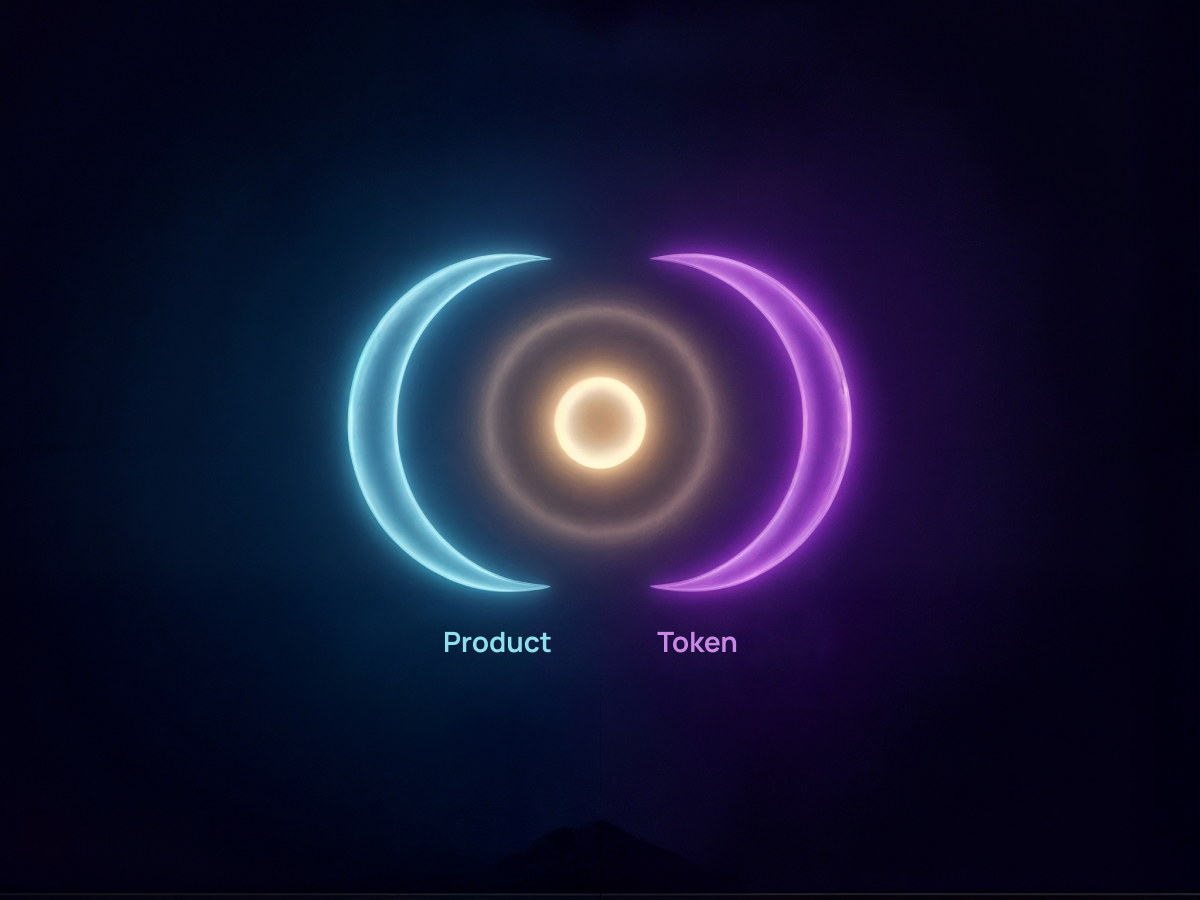
Tokens were supposed to accelerate growth. Instead, most of them drift outside the product – disconnected from users, disconnected from the value the system creates. A token can move on hype for a moment. But it only grows for real when the product gives it something to hold.
Why tokens and products break apart
Teams often design the token economy and the product as if they live in two different worlds. The product tries to find PMF. The token tries to create demand. But the two rarely meet in the middle.
A token can look complete on paper. Distribution charts, emissions schedules, staking rewards, elegant curves – the full tokenomics deck. And yet none of it matters if the product behaves differently from what the model assumed. Most tokens fail for this reason. Not because the market is brutal, but because the token was built without understanding the economics of how the product grows.
The product moves according to user behavior. The token evolves according to design. And when those two paths diverge, the entire model starts to break apart.
A token can outrun the product, rising faster than the system can support. In other cases, the product finds traction but none of that energy returns to the token. And often the token drifts into its own parallel economy, active and noisy, while the product is still trying to find its footing. That disconnect is what destroys long-term token growth models.
The truth is simple. A token doesn’t create value by itself. It only holds what the product makes possible. And without that link, even the strongest design starts to fall apart.
The real work here is bringing the product and the token back into the same motion. Not by tuning numbers, but by aligning the mechanics that drive them. When the design lands, the token moves because the product moves. Not beside it or ahead of it but with it.
What gives the product traction vs what gives the token demand
A product grows only when users find something that keeps pulling them back. That pull doesn’t come from tokens. It comes from behavior – from a problem solved, from a loop that feels natural, from moments where the product quietly becomes part of someone’s routine. These are the signals of PMF, and nothing in the tokenomics layer can replace them.
A token grows for a different set of reasons.
It needs a role inside the token economy that turns user action into actual demand. Not theoretical demand on a slide deck. Real demand that appears because the design ties economic outcomes to how people use the product. This is what token utility design aims to create.
Product traction comes from usage. Token demand comes from structure. One is emotional and behavioral. And the other is mechanical and economic.
A product asks a simple question: Do people return? A token asks a different one: Does the model give their actions weight?
This is where founders slip. They treat the two growth engines as if one will magically fuel the other. But a surge in product usage doesn’t guarantee token value accrual. And a clever token model doesn’t guarantee the product has something worth capturing.
Traction proves the product works. Demand proves the token growth model works. Only when those two forms of proof intersect can the system scale without tearing itself apart.
The flywheel you need
Growth in Web3 doesn’t come from one action. It comes from a cycle.
Users interact with the product, create signals, and those signals feed back into the experience in a way that encourages the next step. That repeating motion is what forms a product loop, the basic engine behind every model that holds attention.
Tokens have their own engine. When a user acts, the model creates something the token can absorb – access, priority, rewards, or economic weight. That outcome gives people a reason to participate again, which strengthens the loop. And this is the foundation of a token loop.
The real shift happens when the two loops stop running separately and start reinforcing each other. Product actions create token demand. Token dynamics strengthen product behavior. With each cycle, the motion tightens.
That’s when a flywheel forms, not a diagram. A system where usage fuels value, value fuels usage, and the model no longer needs constant pressure to move.
Weak designs try to push the loops manually. Strong designs let the loops push each other.
Designing the token-product model
You can’t connect a token to a product by forcing utility into random features. The model has to grow out of what users already do. Every meaningful design starts by mapping real actions inside the product and deciding which of them the token should amplify.
Some actions create momentum. Others create commitment. And some create value the ecosystem can hold. That’s where token utility design begins – not with imagination, but with behavior.
Once the actions are clear, the next step is shaping token distribution so the right people hold the right parts of the supply at the right stage of growth. Early users shouldn’t carry the same weight as long-term contributors. And contributors shouldn’t carry the same weight as passive holders. Distribution is a growth tool, not a spreadsheet.
Incentives come last. Not as rewards, but as guidance. A good token growth model nudges users toward behaviors the product already depends on. A bad model bribes people into actions that collapse the moment rewards stop.
When the pieces align across actions, distribution, and incentives, the token economy starts to match how the product works. And that’s when the system finally gains the ability to scale without tearing itself apart.
Making the model survive the real market
A token-product model may look balanced in theory, but the market tests every weak point the moment it goes live. Volatility doesn’t break a strong design. It exposes a fragile one.
The first stress point is liquidity. A token with shallow liquidity on a DEX becomes unpredictable. Small orders distort price, incentives stop working the way they were intended, and the model begins reacting to noise instead of behavior. Good liquidity design has nothing to do with size. What matters is stability and whether the token economy can absorb pressure without losing its shape.
The next pressure comes from decentralization. Every Web3 system needs some level of it, but too much control handed too early can freeze the model. Too little control creates the opposite problem: nobody can correct course when the data shifts. Strong models accept the trade-off and design governance only where it supports the product’s direction.
And then there’s the market itself. A volatile market pushes tokens faster than the product can handle. If the fundamentals are weak, speculation takes over and the model breaks. And if the fundamentals are strong, volatility becomes noise instead of a threat.
A token that survives real conditions isn’t the one with the best emissions chart. It’s the one whose design keeps working when users arrive, liquidity moves, and the market tests every assumption baked into the model.
How to roll it out without breaking it
A token-product model doesn’t fail at launch. It fails in the steps leading up to it.
Most teams try to activate the entire design at once, and the system bends before it ever has a chance to work. The rollout has to follow the product.
Early on, the only metric that matters is whether users show real behavior the model can build on. Until those signals appear, the team should treat the token as a silent layer in the background, not a growth engine. This is the stage where startups protect themselves from premature incentives and noise.
When the product shows consistent pull, the next step is introducing early mechanics that tie actions to the model. Light value accrual, small utility hooks, or early participation signals. Nothing heavy. The goal is to see whether users respond in a way that aligns with the long-term token economics design.
Only after these foundations hold should teams increase the weight of the model. This is where distribution, incentives, and holding patterns start to shape the motion of the ecosystem. If the alignment is correct, the numbers begin to tell a coherent story. But if something drifts, the data surfaces it immediately.
The common pitfalls are predictable. Incentives introduced too early distort behavior. Token distribution that rewards the wrong group at the wrong time freezes growth. And models that try to skip stages collapse under the first sign of pressure.
A successful rollout feels gradual from the outside but deliberate from within. Each step confirms the previous one. Each metric reflects whether the system can carry more weight. When the structure is sound, the token economy starts moving with the product instead of working against it.
What founders should remember
A token doesn’t create strength on its own. It reflects the strength of the product underneath it. When the product shows real behavior, the token finally has something to anchor to. And when the behavior is weak, every economic layer starts working against the team.
Timing shapes everything. Launch a token too early and it carries pressure the product should have handled first. Introduce it too late and the model struggles to catch up with how people already use the product. The sequence matters more than any chart or emission curve.
Founders don’t need a perfect structure on day one. They need a direction the system can grow into. A model that adapts as the product matures and turns real actions into real demand. A design that helps the ecosystem settle into a rhythm instead of forcing one.
This is why many teams reach out to independent strategy groups like 8Blocks when they start connecting the token to the product. Not for shortcuts. For clarity. For a design that matches what the product already proves in the market.
Tokens grow only when the product gives them something meaningful to hold. Everything else is drift. The teams that understand this build models that last. The ones that ignore it end up fighting their own economics.