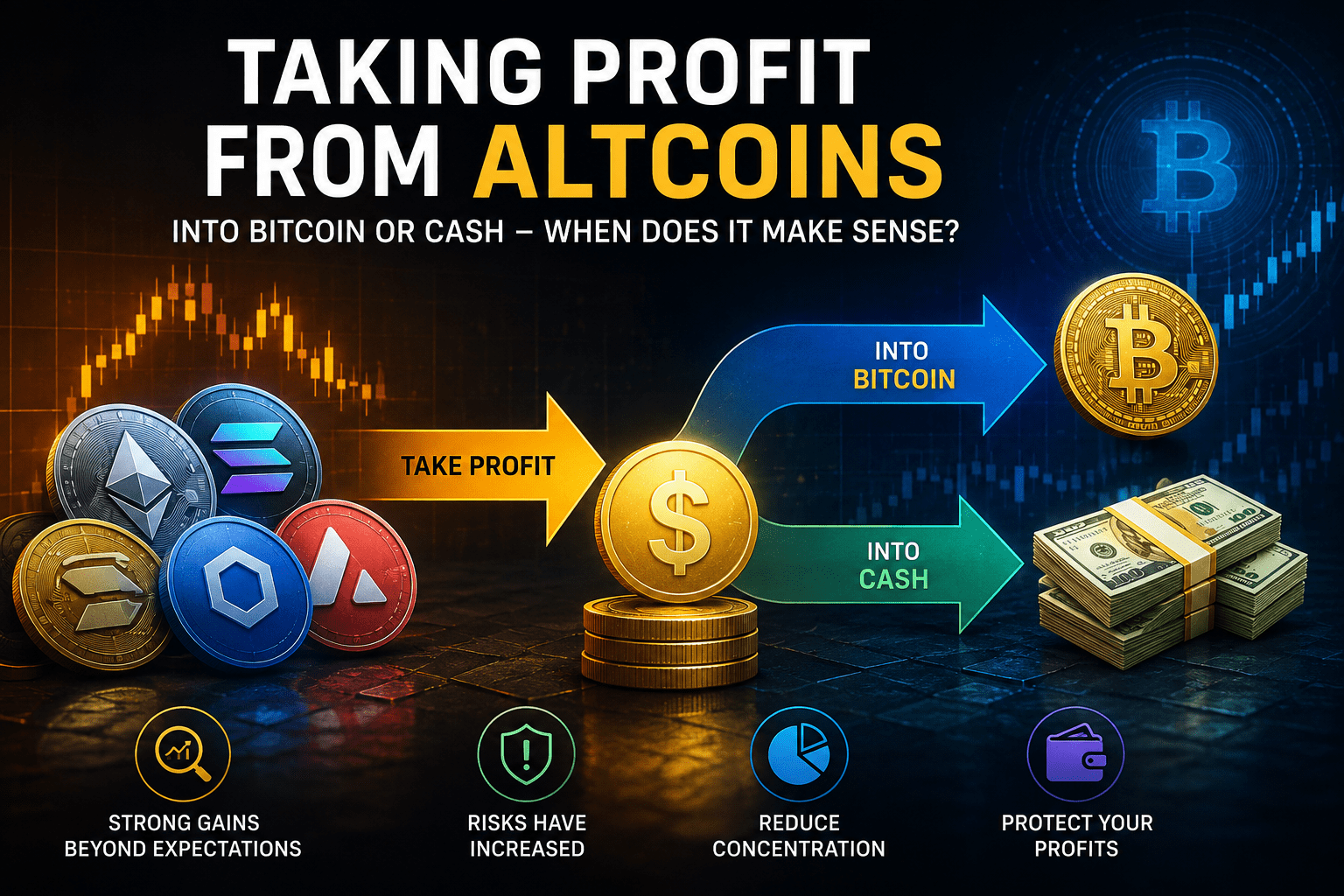
Taking profit from an altcoin can make sense when the position has grown beyond what originally felt reasonable, the project has become less convincing, or you simply want less exposure to that particular coin. Moving into BTC keeps you inside the crypto market, while moving into cash steps away from crypto price risk much more clearly.
The way that makes the most sense to think about profit-taking is as changing your exposure. You are deciding what kind of risk you are comfortable holding next, rather than trying to guess the exact top.
Crypto makes this decision especially noticeable because prices can move quickly. The SEC describes crypto asset investments as exceptionally volatile and speculative, with additional risks including illiquidity and platform failures.
Start With the Reason You Bought the Altcoin
The original reason for buying an altcoin gives you a useful way to judge whether the position still makes sense. A project might have attracted you because of growing users, new technology or an upcoming product, yet months later the price can be much higher while the project has barely changed.
Taking profit can also mean different things. Exchanges and swap services let people convert one token into another, so a crypto swap platform can be used to exchange an altcoin for BTC without leaving crypto. The value remains exposed to crypto prices, while converting to cash removes that direct exposure. Fees, liquidity and exchange rates can affect the amount received.
Price alone therefore tells only part of the story. Crypto can rise on excitement even when development is slow, or fall while a project keeps growing. Comparing the current situation with the original reason for buying gives the price move more useful context.
When the Altcoin Has Risen Faster Than Its Fundamentals
A large price increase becomes more interesting to question when the project behind the token has not improved at anything close to the same pace.
Suppose an altcoin rises 300%. That sounds impressive, and your position would be worth four times its starting value. Yet the important question is what changed during that move.
Sometimes there is a real explanation. The network gained users, revenue increased, an important product launched, or demand for the token changed. Other rallies are mostly driven by hype, social media and traders chasing a price that is already moving.
That distinction can be messy with crypto because there is no single number that tells you what a token should be worth. Still, a huge gap between price growth and actual project progress is worth noticing.
Taking some profit in that kind of situation can be viewed less as predicting a crash and more as recognizing that the position now carries a different level of risk.
When the Risks Around the Altcoin Have Changed
Taking profit can also make sense when the coin you own is simply a different proposition from the one you originally bought.
Some changes are fairly visible:
- Trading activity and liquidity have fallen sharply
- The project has suffered serious technical, security or governance problems
- Legal or regulatory developments have changed its outlook
- The team repeatedly fails to deliver major plans
These signals do not automatically mean a token will fall. Markets are rarely that cooperative.
They do mean that the reason for holding the token deserves another look. A 100% gain does not protect you from a later 70% decline, and a popular token does not suddenly become low risk because many people own it.
This is one reason altcoin profits can feel strange. The number on the screen is a gain, while the money is still sitting in the same volatile asset that produced it.
When Moving From an Altcoin to Bitcoin Can Reduce Concentration
Moving an altcoin profit into Bitcoin makes more sense when the idea is to reduce dependence on one smaller crypto project while still keeping exposure to crypto.
Bitcoin is still volatile. That part should not get lost.
The SEC specifically tells investors to consider Bitcoin’s price volatility and describes Bitcoin exposure as highly speculative.
What changes is the type of exposure. Instead of depending heavily on the success of one altcoin ecosystem, the position becomes connected to Bitcoin, the largest crypto asset by market capitalization.
Bitcoin dominance is one common way of viewing its position in the market. The calculation is simply Bitcoin’s market capitalization divided by the total cryptocurrency market capitalization.
That makes an altcoin-to-BTC trade feel more like shifting risk within crypto than actually leaving the market.
When Moving to Cash Changes the Risk Completely
Moving an altcoin profit to cash makes more sense when the goal is to stop exposing that money directly to crypto price movements.
This is a much bigger change than swapping an altcoin for BTC.
If an altcoin is sold for Bitcoin and the entire crypto market falls, the new position can still lose value. If the same value is converted into ordinary cash, a crypto selloff does not directly reduce that cash balance.
There are other considerations, of course. Inflation affects the purchasing power of cash over time, currencies themselves can move, and holding money with a financial institution brings its own considerations.
Still, the distinction is pretty straightforward. BTC means staying in crypto. Cash means taking that portion outside direct crypto price exposure.
Bitcoin or Cash: What Actually Changes?
The choice becomes easier to understand once BTC and cash are treated as two different destinations rather than two versions of taking profit.
| Question | Moving to BTC | Moving to cash |
| Still exposed to crypto prices? | Yes | No direct exposure |
| Exposed to Bitcoin volatility? | Yes | No |
| Less dependent on one altcoin? | Yes | Yes |
| Keeps exposure to a possible crypto rally? | Yes | No direct exposure |
| Can taxes be relevant? | Yes, depending on jurisdiction | Yes, depending on jurisdiction |
Neither destination automatically makes a trade good or bad. They simply leave you holding different risks afterward.
That distinction also explains why someone can say they “took profit into BTC” even though the value of that profit can still move substantially the following week.
Why Taking Only Part of a Profit Feels Different From Selling Everything
Partial profit-taking sits between continuing to hold the entire altcoin position and completely leaving it.
Imagine a position grew from $500 to $2,000. Selling the whole position means giving up all future exposure to that token. Keeping everything means the entire $2,000 remains exposed to whatever happens next.
A partial sale creates a middle ground. Some value moves elsewhere, while some exposure remains.
There is no percentage that magically becomes the correct amount. A 10%, 25% or 50% reduction means very different things depending on how large the position already is and what the person expects from the asset.
The interesting part is the trade-off. You no longer need the token to keep rising for the whole position to work out well, while you also have not completely walked away from it.
Check Taxes, Fees, and Records Before Calling It a Profit
A profitable chart does not necessarily equal the amount you eventually keep because trading fees and taxes can change the final result.
The tax side is easy for a beginner to overlook, especially when swapping one cryptocurrency directly for another.
For example, U.S. rules treat digital assets as property. The IRS says exchanging one digital asset for another can produce a gain or loss that has to be calculated and reported. In other words, swapping an altcoin into BTC can have tax consequences even though no dollars reached a bank account.
Rules differ across countries, so the U.S. example should not be treated as a global rule.
This brings the whole question back to a fairly simple idea. Taking profit into BTC usually means changing which crypto risk you hold. Taking profit into cash means reducing direct crypto exposure. Neither requires knowing exactly where the market tops, which is useful because consistently identifying that exact point is a much bigger claim than simply deciding that an altcoin position now carries more risk than you want to keep.