
The first time a bank blocks your own money, you remember it.
Mine was a Sunday. I tried to move funds to an account, the transaction bounced, and there was no error I could act on. No fraud alert to confirm. No number to call that helped. Just a declined payment and a support rep at the bank who wouldn’t say much beyond “that merchant category is restricted.” The money was mine. It was sitting right there. I still couldn’t move it.
If you bet online in the US, you already know this feeling. And you probably already know how the story ends, because the whole market has been quietly ending it the same way for a few years now: with crypto.
Why US banking fights you
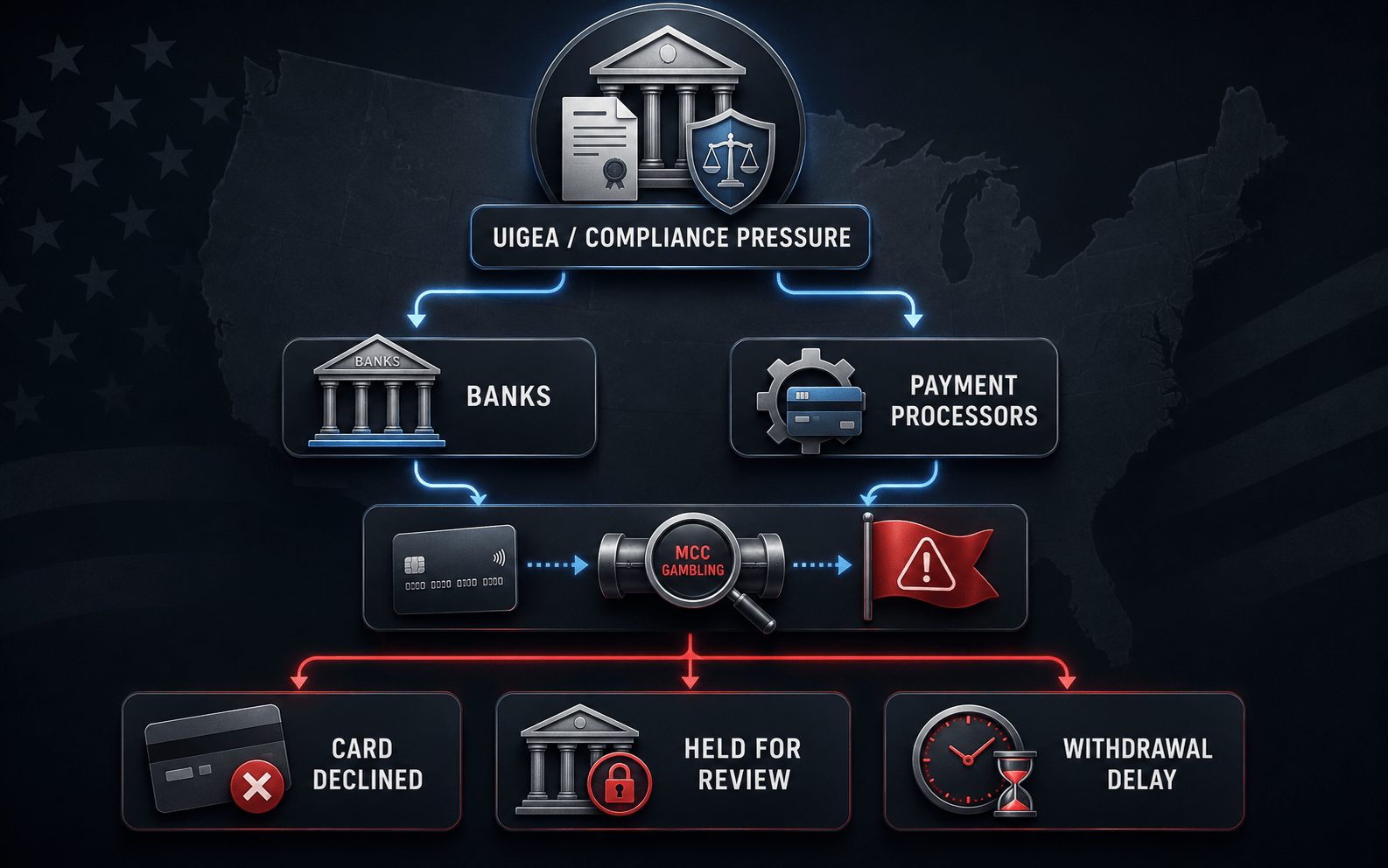
This isn’t the banks being difficult for no reason. It goes back to a 2006 law, the Unlawful Internet Gambling Enforcement Act. UIGEA didn’t ban betting. It did something sneakier. It put the pressure on the payment processors, making them responsible for blocking gambling-related transactions.
So banks did what banks do when a law makes something their liability. They started declining anything flagged with a gambling merchant category code. Cards get rejected. Wires get held for review. Deposits work one week and vanish the next when a processor changes a rule. None of it is consistent, which is the most frustrating part. You never quite know if your money is going to move until you try.
Withdrawals are worse. A bank wire out of an offshore operator can take three to five business days, and that’s the good case. Add a weekend. Add a holiday. Add a “compliance review” that nobody warned you about. A wire started Friday afternoon might not even begin processing until Tuesday. Then there are the fees. Twenty-five to forty-five dollars for the wire itself, plus a foreign-exchange markup that quietly eats another few percent. On a modest withdrawal, you can lose real money just moving your money.
For years, that was the tax on betting online in the US. Slow, expensive, unreliable. You accepted it because there was no alternative.
Now there is.
What crypto actually fixes
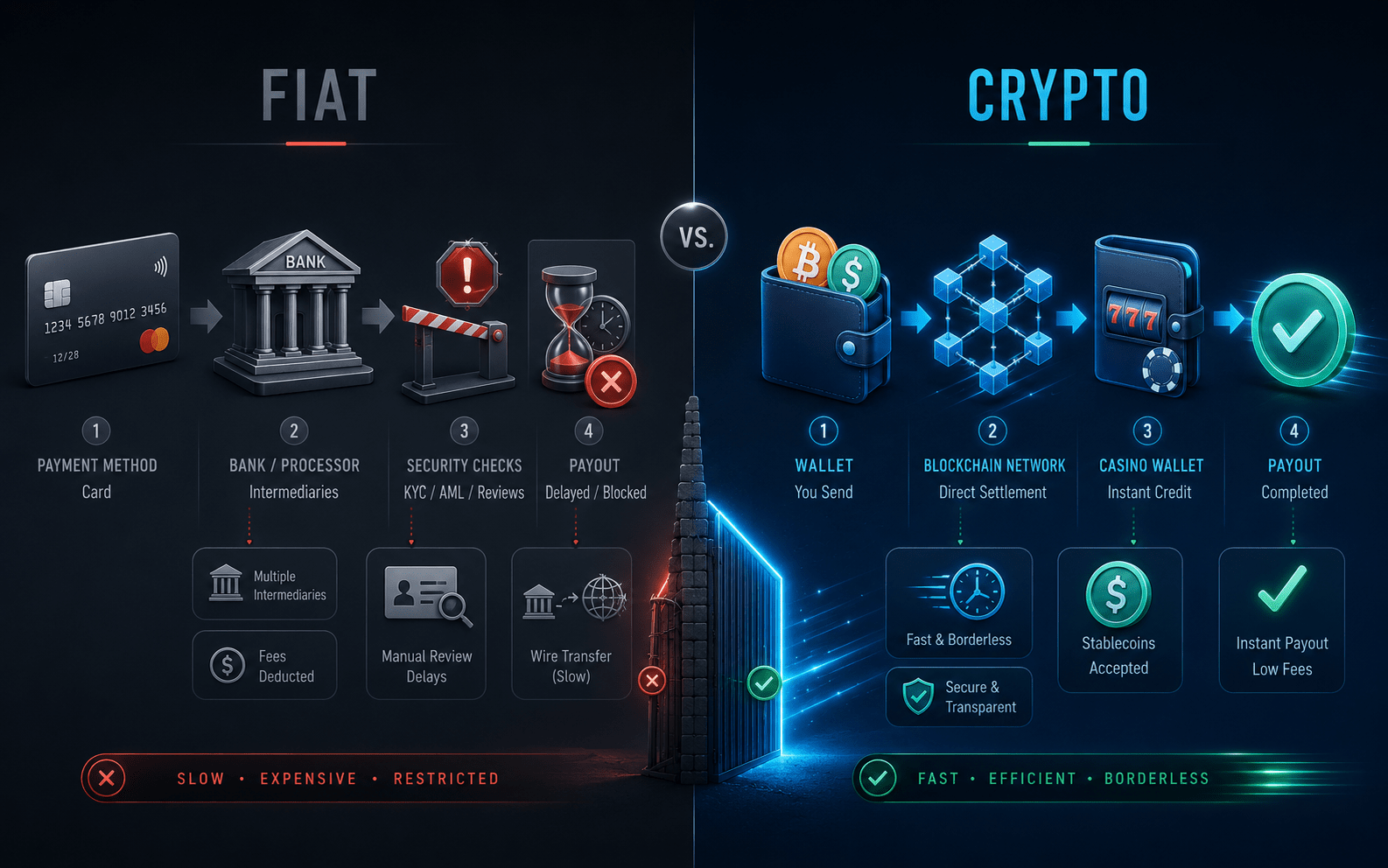
Crypto doesn’t care about your bank’s rules. That’s the entire point. A blockchain transaction doesn’t route through a US correspondent bank that can decline it. It settles directly, peer to peer, on a network that doesn’t know or care what you’re spending it on. No merchant category code. No processor deciding your transaction looks suspicious. No permission required.
For a US bettor, that’s the whole game. The borderless part isn’t a slogan. It’s the mechanism. When your money moves on a blockchain instead of through the domestic banking system, the domestic banking system’s hostility to gambling simply stops applying.
And it’s fast. This is where the difference stops being incremental and starts being absurd. A USDT transfer on the Tron network settles in a minute or two and costs a fraction of a cent. Bitcoin’s Lightning Network is close to instant for pennies. Even regular on-chain Bitcoin, which is the slow option in crypto terms, clears in ten to thirty minutes. Compare that to the three-to-five-day bank wire. It’s not the same category. It’s not even the same conversation.
The speed varies by operator, though, not just by network. A casino running fast crypto rails on paper can still sit on your withdrawal for a day in “pending review” if their internal approval process is slow. This is why reviewing payout speeds at top US crypto casinos matters as much as picking the right coin. The network sets the floor for how fast a payout can be. The operator decides whether they actually hit it. Two casinos both advertising “instant Bitcoin withdrawals” can perform completely differently once you request an actual cashout, and the only way to know is to look at what real payouts actually clock in at.
The industry had to adapt
Here’s the part operators don’t say out loud: crypto forced their hand.
Once a few casinos started paying out in minutes, “3-5 business days” stopped being an acceptable answer. Players noticed. Players talk. A bettor who gets paid in ten minutes at one site is not going back to a site that makes them wait a week. Payout speed went from a footnote to a feature, and then from a feature to a deciding factor.
So the operators competed. The good ones raised auto-approval thresholds so that most withdrawals never touch a human reviewer. They started holding enough crypto in operational wallets to pay out on demand instead of shuffling funds around before every cashout. They integrated the faster networks. The whole competitive floor moved, and it moved because crypto made slow withdrawals look as outdated as they actually are.
The operators that didn’t adapt are still around. They’re just losing the players who care about getting paid.
The mechanics worth understanding
Crypto isn’t magic, and pretending it is does you no favors. A few things actually matter if you’re going to use it.
The network matters more than the coin. USDT on Tron is cheap and fast. The same USDT on Ethereum’s main network can cost you real money in gas fees when the network is busy. Same asset, completely different experience. Always check which network an operator is using before you send anything.
Volatility is a real cost on Bitcoin. If you deposit in BTC and its price drops 4% while you’re playing, you just lost 4% before you placed a single bet. This is why a lot of experienced players use stablecoins like USDT or USDC instead. You get the speed and the bank-independence without turning every session into a side bet on the crypto market.
Self-custody means the responsibility is yours. There’s no chargeback on a blockchain. Send to the wrong address and it’s gone. That’s the trade for a system with no bank in the middle. It’s not hard to get right, but you have to actually pay attention. Copy the address. Check it. Send a small test amount first if the withdrawal is large.
And regulation is thinner. Most crypto-first casinos serving US players run offshore, under lighter oversight than a regulated domestic operator would face. The slow bank rail you’re escaping does come with some consumer protections that crypto doesn’t. That’s not a reason to avoid it. It’s a reason to stick to operators with real track records and verifiable payout histories rather than whatever site has the biggest bonus banner.
Where this is going
The direction is settled even if the finish line isn’t. Fiat isn’t disappearing from US betting overnight. Some players will always want a card and a bank statement. But the momentum is entirely one way. Every year, more operators lead with crypto, more players fund with stablecoins, and the gap between a same-day crypto payout and a week-long wire gets harder to justify.
The banks made betting money slow and expensive to move. Crypto made it fast and cheap. In a market where the whole point is getting your winnings without a fight, that was never going to be a close call.
Fund smart, use the right network, stick to operators that actually pay, and the single most annoying part of betting online mostly goes away.