A few years back, adding swap functionality was a heavy lift. You paid licensing fees and spent months on backend work before the first transaction could clear. That era has mostly ended.
The crypto exchange APIs worth a look in 2026 ask for nothing upfront. Integration is free, and revenue flows from transaction-based commissions that the provider and the partner share. After a full look at the market, we picked ChangeNOW as the best crypto exchange API with free integration and a revenue share model. Several other providers deserve a place on the list too, and this piece covers all of them.
How We Selected These APIs
Three factors separate a usable exchange API from a risky one. Every platform here was measured against the same criteria.
Assets Available. Asset count decides what your users can actually swap. Take an API that carries 500 tokens. On paper it reads fine. Then a user goes looking for a mid-cap altcoin on a newer L2 and finds an empty result. Wider coverage keeps more swaps from failing, and your support queue feels the difference. Cross-chain reach matters at a similar level. Build on EVM alone and you lose the Solana, Cosmos, and Bitcoin-native users.
Commission. Commission structure drives unit economics. For most free-integration APIs the model is revenue share. The provider keeps a base cut on every swap, and you layer your own percentage above it. Real earnings depend on a few details working in your favor. One is the baseline rate. Another is whether you can tune it pair by pair. The last is the payout mechanics, meaning crypto or fiat settlement, the minimum thresholds, and how often money moves.
Free Plan. A handful of providers drop the paid tier entirely. The API key costs nothing, rate limits stay roomy, and all the provider’s money comes from swap commissions. That gap is the first thing to check when you run an early-stage product or an MVP. Genuinely free infrastructure lets you ship while exchange connectivity stays off the budget sheet.
Comparison Table
| API provider | Total assets | Chains | Commission model | Key differentiator |
| ChangeNOW | 1,500+ | 90+ | From 0.4% rev share, configurable per pair | Fiat on/off-ramp + fastest deposit speeds |
| RocketX | 15,500+ | 200+ | 0.2–0.4% platform fee, 50/50 split with partner | Native cross-chain routing |
| Swapzone | 4,000+ | Multi-provider | 0.25% fixed plus optional markup | Rate-neutral aggregation across 30+ providers |
| Houdini Swap | 4,000+ | 100+ | Commission per swap, rate set during onboarding | Private swaps via two-exchange routing |
| Flashift | 2,500+ | 100+ | Zero platform fee, partner sets custom markups | AI-powered best-rate selection |
| Exolix | 1,755+ | 200+ | 0.5–0.7% rev share in BTC | Fixed-rate locking plus white-label modules |
Data sourced from official websites as of October 2026. Actual terms may vary – verify directly with each provider before integrating.
ChangeNOW
Our top pick is the non-custodial crypto exchange API from ChangeNOW. It reaches 1,500+ assets across 90+ blockchain networks and sources swaps from aggregated CEX and DEX liquidity. You sign no subscription, pay no setup fee, and face no paid tier later on. Partners earn from 0.4% on each completed transaction, with the markup set however you like.
The technical side holds up. Response times land near 350ms, and uptime holds around 99.99%. Rate limits run to 1,800 calls a minute, which covers a project all the way from a weekend prototype up to a production wallet on one plan. Deposit speed is a real edge here. Polygon deposits clear in 7 blocks against 250 to 700 at major CEXs, and Monero needs 5 blocks against a market average closer to 20 to 150.
Payouts arrive instantly, in fiat or across 11 selected cryptocurrencies. Most teams move a full API integration from setup to production in roughly a week. If you build wallets, payment platforms, or portfolio apps, the broad asset coverage and the flexible fee settings make ChangeNOW an easy default to reach for.
RocketX

RocketX runs as a hybrid CEX-DEX aggregator over 200+ blockchains, drawing trades from hundreds of exchanges behind one API endpoint. The platform has run since 2021, and every API integrator gets fee sharing by default. RocketX also offers private swaps for users who want more confidentiality on cross-chain transactions.
Cross-chain is the real pull. A typical exchange API keeps a swap inside one network. RocketX carries it across networks in one call, say ETH into SOL, or BNB into USDC on Arbitrum. Coverage climbs past 15,500 tokens. Standard pairs quote back in under a millisecond.
For teams that put cross-chain coverage ahead of single-network depth, RocketX offers the broadest chain support on this list. Zokyo and Network Intelligence have both audited the platform. One thing to know: the native RVF token gives fee discounts and revenue share to holders, but that sits on the user side. API partners earn through the default fee-sharing model.
Swapzone
Swapzone works differently from the single-provider options here. Rather than routing through its own liquidity, it aggregates 30+ exchange providers and returns their live offers side by side through one API call. The partner earns a fixed 0.25% on each completed swap, with the option to add a markup, whichever provider ends up executing it.
The aggregated pool holds 4,000+ tokens. For integration you get a few routes, from a full REST API down to an embeddable widget or a plain referral link. A standard build usually ships somewhere inside a two-day to two-week window, set by how far you take it. Setup and monthly fees are both zero.
Because Swapzone earns the same affiliate commission whichever provider wins a swap, it has no reason to steer users toward one exchange. For platforms that want to show users a rate comparison, with several offers laid out side by side instead of one pre-selected rate, the aggregator approach fits that job better than a single-provider API.
Houdini Swap
Houdini Swap is a privacy-focused, non-custodial cross-chain aggregator, now owned by SOL Strategies. It supports 100+ chains and 4,000+ tokens, with 34 integrated exchange providers at launch. The platform has processed around 80,000 transactions worth close to $200 million across 60,000 users.
Privacy routing is the core product. A Houdini private swap passes through two independent non-custodial exchanges, with a randomized Layer 1 asset sitting between them. The first exchange sees where the funds came from but has no view of the destination. The second sees the destination but nothing about the origin. That break in the path hides the on-chain trail between sender and receiver wallets.
The API also handles batch swaps, where one request pays several recipients. Fixed-rate locking gives price certainty, and DEX or bridge routing covers on-chain swaps. Revenue share terms come through the partner program, though the exact rate requires direct negotiation.
Flashift

Flashift’s own interface lists around 300 tokens for direct selection. Across 15+ exchange providers, the API reaches roughly 2,500+ tokens on 100+ blockchains for integrators. The launch came in 2025. The platform adds zero commission on swaps, so integrators earn through custom markups they set on specific pairs.
AI-driven rate selection is Flashift’s differentiator. The platform uses machine learning to find the provider with the current best rate, weighing KYC probability and execution speed alongside price. It automates the manual comparison users would otherwise do across standard aggregators.
Flashift routes through 50+ exchange providers with automatic failover. When a provider drops offline or returns a slow quote, the system reroutes on its own and the user’s flow stays intact. Flashift also connects to Telegram bots, letting developers drop swap functionality right into chat-based products with no traditional web interface.
Exolix
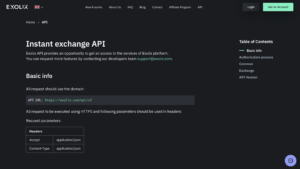
Exolix has run since 2018. The platform lists 1,755+ cryptocurrencies on 200+ blockchains, covering around 4 million trading pairs. Roughly 130 partners run the Exolix API in production today, with Bitcoin.com, D’CENT, and Monerujo on that list.
Partners collect 0.5% to 0.7% per completed transaction, scaled to volume. BTC payouts show up on a live dashboard. There’s a white-label option as well. A partner picks up a module, adds branding of their own, and runs a full swap service on their domain, with Exolix keeping the backend alive underneath.
A team after a simple, dependable swap API with a long record and clear revenue share will get that from Exolix. The trade-off is a lighter routing feature set next to aggregators like Swapzone or Flashift. Running on one provider, Exolix shows a single rate where an aggregator shows a spread.
Conclusion
All six clear the upfront cost barrier. And the pick comes down to your product. Single-provider APIs like the registration-free crypto exchange API ChangeNOW and Exolix give you direct liquidity with simpler integration paths. Aggregators such as Swapzone and Flashift hand back a spread of offers per request, which lands well when rate transparency is part of the pitch. RocketX holds the cross-chain niche at 200+ chains. Houdini Swap earns its spot where transaction privacy ranks as a core requirement.
Try two before you settle on one. Run the same pair through each, weigh the returned rate against the advertised figure, and clock the response. Confirm the pair you lean on most has real support behind it. The winner is the API whose live behavior fits how your product runs each day.