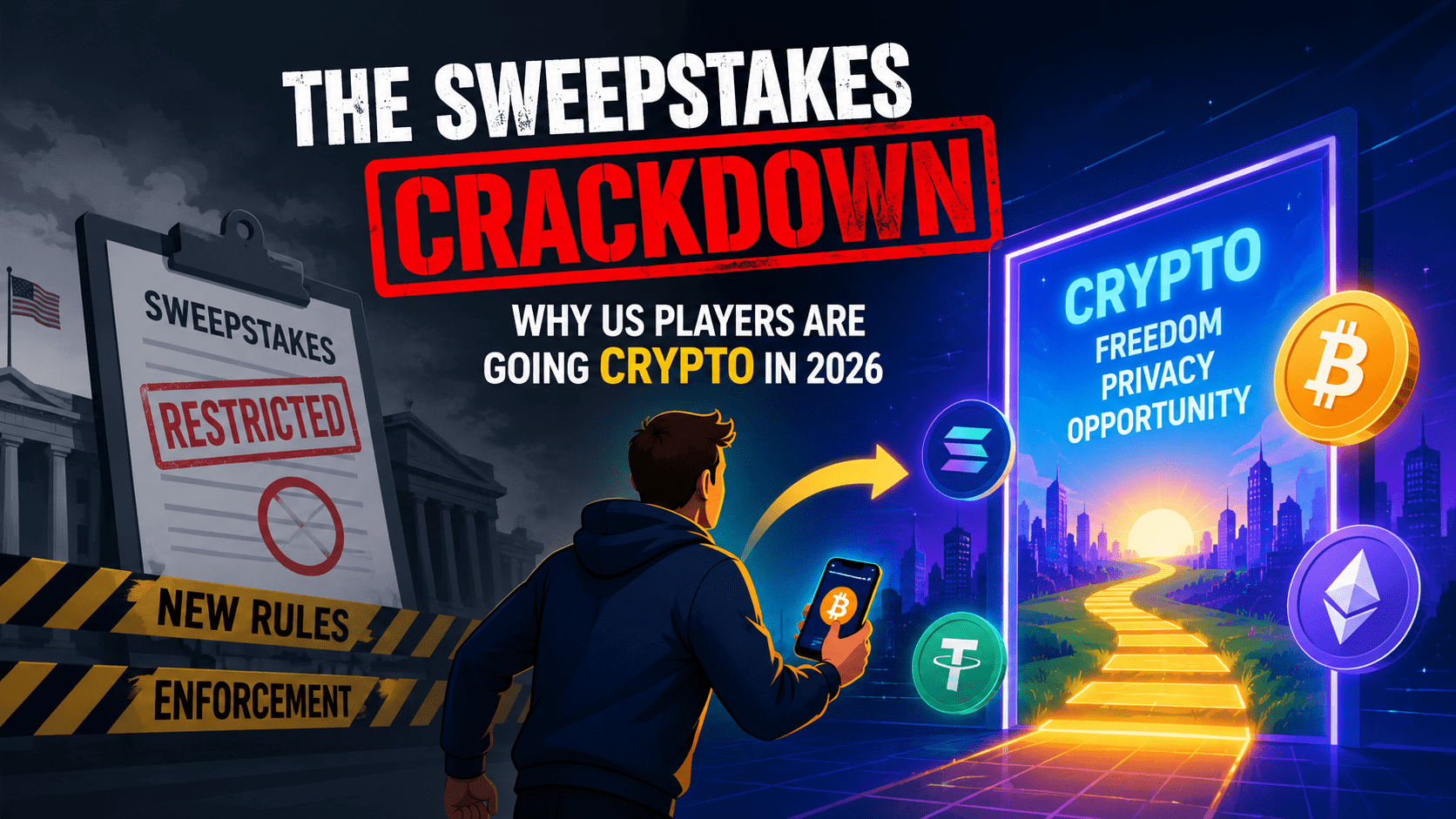
State after state is pulling the plug on sweepstakes casinos. The model that let millions of Americans play outside the eight legal iGaming states is unraveling fast, and crypto is catching most of the overflow.
For most of the last decade, the question “can I play online casino games in the US?” had a workaround. Real-money online casinos were legal in only a handful of states, but sweepstakes sites filled the gap almost everywhere else. In 2026 that workaround is falling apart, and the timing is brutal for the players who relied on it.
The collapse moved fast, state by state:
- May 2025: Montana becomes the first state to ban the model.
- Late 2025: Connecticut and New Jersey follow.
- 1 January 2026: California’s ban takes effect and wipes out close to a fifth of the entire sweepstakes market in a single day.
- Early 2026: New York, Nevada, Indiana, Maine, Oklahoma and Tennessee line up behind it.
- June 2026: Operators like Mega Bonanza and Jackpota pull out of states where enforcement actually has teeth.
How the loophole worked
The sweepstakes model was clever. Players bought “Gold Coins” purely for entertainment and received free “Sweeps Coins” they could redeem for cash. Because no real money was technically wagered and a free entry path existed, the sites sidestepped gambling law altogether. That one distinction let brands like Chumba, McLuck and Stake.us reach more than 45 states and pull in somewhere between 6.9 and 14 billion dollars in 2025, depending on whose numbers you trust.
The push to shut it down did not come from anti-gambling crusaders. It came from the American Gaming Association, the trade group for licensed and taxed casinos, which spent two years lobbying state by state against what it framed as untaxed competition. Today real-money online casinos remain legal in only eight states: New Jersey, Pennsylvania, Michigan, West Virginia, Connecticut, Delaware, Rhode Island and Maine. Everywhere else, the legal route just got narrower.
Why players are moving to crypto casinos
So where does someone in Texas or Georgia turn now? For a growing number, the answer is crypto. Offshore crypto casinos run on real money rather than coins-for-fun, which places them in a completely different category from the sweepstakes sites being banned. They settle in everything from Bitcoin and Ethereum to stablecoins. Many ask for nothing beyond an email to sign up, and they pay out in minutes instead of days. For people who just lost their sweepstakes accounts, real-money bitcoin casinos usa have quietly become the obvious next stop.
The fit is not an accident. The features that make crypto casinos appealing are the exact things sweepstakes players are about to lose: instant access, no drawn-out verification, and balances they can move on and off a platform freely. Stablecoins matter most in this shift. USDT and USDC let players deposit and cash out without watching the value swing mid-session, and on networks like Tron the fees sit close to a dollar. That removes the single biggest thing that kept casual players away from crypto in the first place.
The part nobody advertises
There is a catch worth stating plainly. Offshore platforms sit outside US regulation, which means thinner consumer protection and no local authority to turn to when something goes wrong. The bans themselves almost always target operators rather than players, with one exception that matters. In Washington State, the law can reach individual bettors, not just the sites. Anyone considering this route should know precisely where their own state stands before depositing a cent.
Crypto casinos are not the only ones absorbing the overflow, either. Prediction markets are pulling in a slice of the same crowd. On-chain prediction volume reached roughly 36 billion dollars in the first quarter of 2026, overtaking on-chain casino gambling for the first time. Platforms like Polymarket and Kalshi, recently joined by a Crypto.com app built for US users, let people bet on real-world outcomes in a space regulators are still scrambling to classify. Polymarket alone settles entirely in the stablecoin USDC, which keeps a position steady while the market plays out. For a certain type of player, that ambiguity is the whole appeal.
What to look for in a Bitcoin casino
If you are weighing the switch, the checklist is short but non-negotiable:
- A real license, even a Curacao one
- Clear, stated withdrawal terms
- Provably fair games you can verify on-chain
- Responsible gambling tools that actually function
A site accepting Bitcoin, a stablecoin, or one of the meme coins many tables now take tells you nothing about whether it pays out cleanly. Treat the crypto part as a payment rail, not a seal of approval.
The sweepstakes era is closing, and it is closing quickly. What replaces it is messier, less regulated, and built on infrastructure most US players are only beginning to understand. Crypto did not cause the exodus, but it is catching most of the people walking out the door. For an industry that spent a decade in a legal gray zone, 2026 is simply the year the gray turned a different shade.