Livepeer Begins Routing Agent Fees to the Open Network on November 15
go-livepeer ran the network for almost nine years; the new node stack is designed for workloads handled by agents, with node rewards tied to real fee revenue.



Key Takeaways
- Livepeer begins routing Livepeer Agent fees to the open network on November 15, 2026.
- The change is part of the move from go-livepeer, which ran the network for almost nine years, to a new node stack built for agent workloads.
- Under the Livepeer 2.0 model, a node's LPT reward is the smaller of its share of network fees and its share of network stake.
- Livepeer Agent, the network's product for AI media creation, launched on October 30, 2026.
Livepeer (LPT) begins routing Livepeer Agent fees to the open network on November 15, 2026, according to an announcement from the project. Fees paid for AI media work booked through the agent product now flow to the node operators and delegators who run the network.
What Changes With Livepeer Agent Fees
Livepeer Agent is the network's product for AI media creation, and it launched on October 30, 2026. Until now its fees sat outside the open network's reward flow. From November 15 those fees are routed to the network itself, so the operators providing GPUs and the LPT holders backing them earn from agent workloads. The change turns real usage of the agent product into revenue for the open network.
From Go-Livepeer to a New Node Stack
Livepeer, founded in 2017 by Doug Petkanics and Eric Tang, runs decentralized video infrastructure on Ethereum (how Livepeer works). The fee routing is part of a larger transition. go-livepeer, the original node software, ran the network for almost nine years. The project is replacing it with a new node stack designed for the workloads agents bring, such as transcoding and inference jobs booked through Livepeer Agent. The project's announcement describes the two changes together.
How Rewards Work in Livepeer 2.0
Under the model outlined in the project's protocol evolution post, a node's LPT reward for a round is the smaller of two numbers: its share of network fees and its share of network stake. The design is called Min-Fee-Stake. Fees themselves are never capped, so handling more work always pays the node operator more, and the model pushes stake toward nodes that win real work.
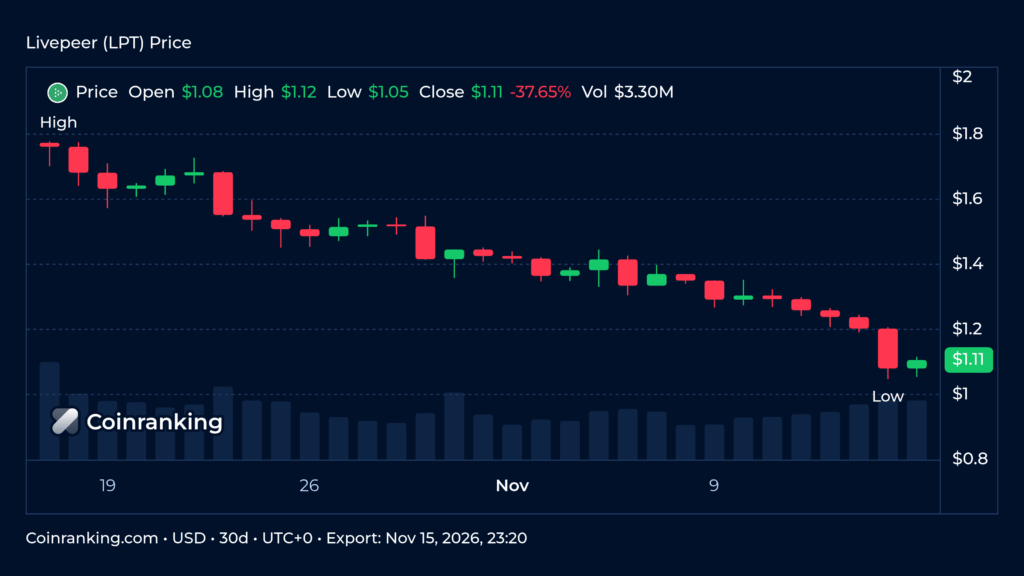
Delegation becomes an active job in this model, since moving stake to a busy but under-staked node raises its reward ceiling. Anyone can register as a node operator in the new model, with no fixed bond and no 100-node cap. The top 33 nodes by total stake can register as validators and score the work they see, and rewards take 7 rounds to become claimable. Livepeer traded near $1.11 on November 15, 2026, on the live LPT chart.
Frequently Asked Questions
What Are Livepeer Agent Fees?
Agent fees are payments for AI media work, such as video transcoding and inference, booked through the Livepeer Agent product that launched on October 30, 2026.
When Do Livepeer Agent Fees Start Flowing to the Network?
November 15, 2026, when the routing change goes live and fees begin reaching node operators and delegators.
How Are Livepeer Node Rewards Calculated?
In the Livepeer 2.0 model, a node's LPT reward is the smaller of its share of network fees and its share of network stake for the round.
What Is Go-Livepeer?
go-livepeer was the node software that ran the Livepeer network for almost nine years before the move to a new node stack built for agent workloads.
Do LPT Holders Need to Do Anything for the Fee Change?
No action is required. Delegators earn through the nodes they already back as agent fees arrive.
Sources
- Livepeer announcement on agent fees and the new node stack · Livepeer on X
- Livepeer 2.0 Protocol Evolution · Livepeer blog
- Livepeer 2.0: The Open Video Agent Platform · Livepeer blog
- Prices and market data · Coinranking