Osmosis Restarts Block Production After a Four-Hour Network-Wide Halt
Upbit suspended OSMO deposits and withdrawals during the outage while trading stayed open, and Osmosis says no funds were lost.



Key Takeaways
- Osmosis stopped producing blocks late on November 12, 2026, in a network-wide stall.
- Block production resumed after roughly four hours, and no funds were reported lost.
- Upbit suspended OSMO deposits and withdrawals during the outage while OSMO trading stayed open.
- Osmosis told node operators to run the official v32.0.0 binary or rebuild with Go 1.26.10 before restarting.
Osmosis (OSMO), the Cosmos-based decentralized exchange chain, stopped producing blocks late on November 12, 2026, in a network-wide stall that lasted roughly four hours before block production resumed. Upbit, South Korea's largest exchange, suspended OSMO deposits and withdrawals during the outage, and no funds were reported lost.
How the Osmosis Halt Unfolded
The network began stalling around 22:57 UTC on November 12, 2026, and stopped producing new blocks, according to crypto.news' report on the Upbit suspension. Validators and node operators coordinated a restart over the following hours. Block production resumed after roughly four hours, and no on-chain rollback was needed.
The deeper technical cause has not been confirmed in public reporting. Osmosis' recovery guidance, reported by TokenPost, notes that nodes built with Go 1.23 may remain stuck at the halt height, which suggests a software compatibility issue in some node builds, but the project has not published a root-cause analysis.
Upbit Pauses OSMO Transfers
Upbit responded to the network failure by suspending OSMO deposits and withdrawals on November 13, 2026. OSMO trading on the exchange stayed open throughout. Exchange-side transfer pauses are standard practice when a chain stops producing blocks, because on-chain deposits cannot confirm while the network is stalled.
What Node Operators Were Told to Do
Osmosis issued recovery guidance for operators whose nodes stayed stuck at the halt height. Nodes built with Go 1.23 may not restart cleanly. The guidance is to use the official v32.0.0 binary or rebuild with Go 1.26.10, then run osmosisd rollback once and restart the node, according to the recovery steps reported by TokenPost.
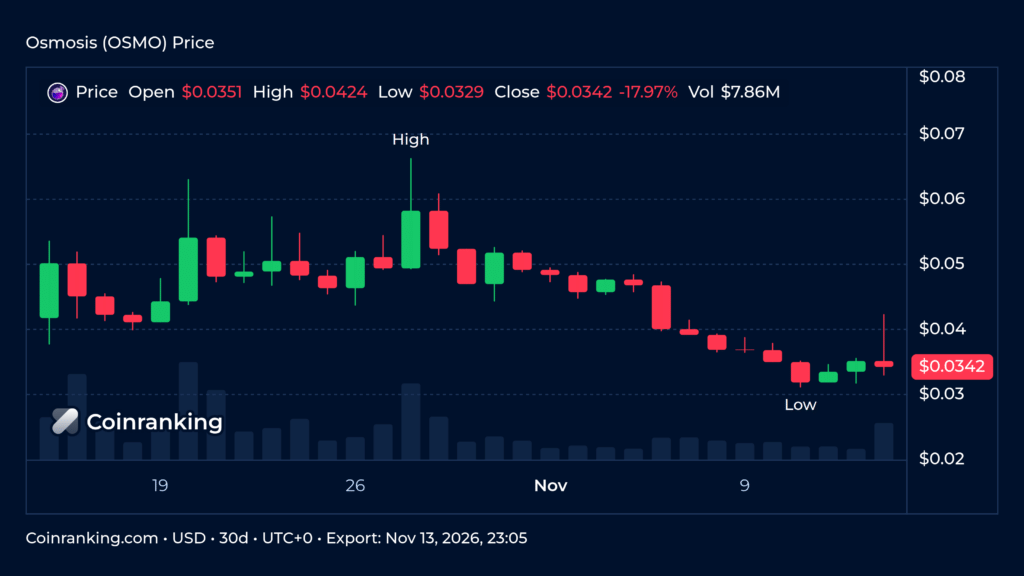
Users holding OSMO on the Osmosis network or on exchanges did not need to take action, and no funds were lost in the outage. Market participants can track the OSMO reaction on the Osmosis price chart as the network returns to normal block times.
Frequently Asked Questions
When Did the Osmosis Network Halt?
Osmosis began stalling around 22:57 UTC on November 12, 2026 and stopped producing new blocks.
How Long Was Osmosis Down?
Block production resumed after roughly four hours on November 12 and 13, 2026.
Were Any Funds Lost in the Osmosis Outage?
No. No funds were reported lost and no on-chain rollback was needed.
Why Did the Osmosis Blockchain Stop?
The root cause has not been confirmed publicly. Osmosis' recovery guidance noted that nodes built with Go 1.23 could stay stuck at the halt height, pointing to a possible software compatibility issue.
Did Upbit Stop OSMO Trading during the Halt?
No. Upbit paused OSMO deposits and withdrawals only. Trading on Upbit stayed open.
Sources
- Upbit suspends Osmosis deposits, withdrawals after blockchain outage · crypto.news
- Osmosis recovery guidance for node operators after the network halt · TokenPost
- Prices and market data · Coinranking