TokenLogic Proposes Aave Reserve Factor Changes for a $3.5M Treasury Boost
A November 12, 2026 proposal adjusts 54 reserve factors across Aave V3 deployments and Aave V2 on Ethereum, modeled to add about $3.5 million a year for the treasury.



Key Takeaways
- TokenLogic submitted the reserve factor proposal to the Aave governance forum on November 12, 2026.
- The proposal adjusts 54 reserve factors across 12 Aave V3 deployments and Aave V2 on Ethereum.
- The model shows about $3.5 million a year in extra treasury revenue, with the blended reserve factor moving from 12.0% to 12.7%.
- Governance has not approved the changes; community feedback comes before an on-chain vote.
TokenLogic submitted a proposal on November 12, 2026 to change reserve factors across 54 Aave (AAVE) markets, covering 12 Aave V3 deployments plus Aave V2 on Ethereum. Using Aave balances and rates from November 9, the model projects about $3.5 million in extra annual revenue for the protocol treasury. Governance has not approved the changes.
How the Aave Reserve Factor Works
The reserve factor is the share of borrower interest that accrues to the protocol treasury instead of liquidity suppliers. It is set per asset by governance. If borrowers pay 100 dollars of interest and the reserve factor is 20 percent, 20 dollars go to the treasury and 80 dollars go to suppliers. Changing the factor moves the split without changing the interest borrowers generate.
Under the proposal, TokenLogic's blended reserve factor rises from 12.0% to 12.7%. The submission is live on the Aave governance forum as a direct-to-AIP item.
Which Markets Change
The proposal adjusts 54 reserve factors across Aave markets. Two examples called out in the submission: Ethereum Core DAI moves from a 25% reserve factor to 30%, and Avalanche V3 USDC moves from 10% to 25%. Borrower rates do not change immediately, while the supplier share of interest falls in the affected markets. TokenLogic frames part of the plan as rebalancing incentives across legacy markets while newer Aave infrastructure is adopted.
What Happens Next
The plan goes to community feedback first, and an on-chain governance vote follows if the discussion is favorable. Aave has run several governance proposals this month, including reserve and cap changes on V3 and V4 markets. The reserve factor numbers are a modeled snapshot, not a guaranteed result.
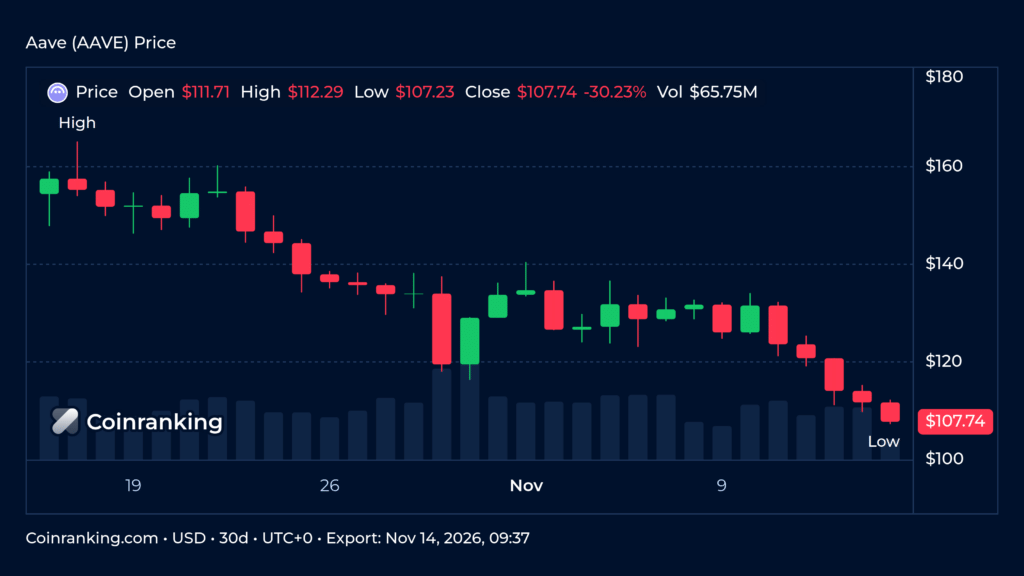
AAVE traded around $107.63 on November 14, 2026, and the Aave price chart shows the market context while the proposal is discussed.
Frequently Asked Questions
What Did TokenLogic Propose for Aave?
On November 12, 2026, TokenLogic proposed changing reserve factors across 54 Aave markets, covering 12 Aave V3 deployments and Aave V2 on Ethereum, to increase treasury revenue.
What Is an Aave Reserve Factor?
It is the share of borrower interest that goes to the Aave protocol treasury instead of liquidity suppliers. It is set per asset through governance.
How Much Revenue Would the Aave Reserve Factor Change Add?
The model projects about $3.5 million a year in extra treasury revenue, using Aave balances and rates from November 9, 2026.
Has the Aave Reserve Factor Proposal Passed?
No. Governance has not approved it. The plan goes to community feedback first, then to an on-chain vote if the discussion is favorable.
Do Borrower Rates Change under the Aave Proposal?
Not immediately. Borrower rates stay as they are, while suppliers receive a smaller share of interest in the affected markets.
Sources
- [Direct-to-AIP] Reserve Factor Updates Across Aave V3 and V2 Markets · Aave governance forum
- TokenLogic Proposes Aave Reserve Factor Changes for $3.5M Annual Treasury Boost · KuCoin
- Prices and market data · Coinranking