Cardano Tags Node 11.2.0, Setting Up the Dijkstra Testnet Hard Fork to Version 12
The Dijkstra testnet still runs node 11.1.3 and Conway protocol version 11, with one-day epochs and a public faucet for operators.


Key Takeaways
- Cardano node 11.2.0 was tagged on GitHub on October 27, 2026.
- The public Dijkstra testnet runs node 11.1.3 and Conway protocol version 11 until the hard fork.
- Intersect expects a hard-fork initiation action to move the testnet to protocol version 12 after the node 11.2 prerelease.
- Node 11.2 leaves Leios out; Leios is tested on the separate MusashiNet prototype network.
Cardano (ADA) node 11.2.0 was tagged on GitHub on October 27, 2026, with the 11.2 release preparation merged. Stake pool operators will run it before a hard-fork initiation action moves the public Dijkstra testnet to protocol version 12, according to the cardano-node repository.
What the Cardano Node 11.2 Release Covers
Node 11.2 carries the full Dijkstra hard fork feature set apart from Leios, the scaling upgrade, Intersect said in Upgrade Bulletin #39 on October 22. The release is also expected to clear the new ledger state model (LSM) for mainnet use, with memory requirements estimated at about 12 GB when running with LSM. The Dijkstra testnet still runs node 11.1.3 and Conway protocol version 11. Operators join it with public configuration files and a testnet faucet, and testnet epochs last one day.
How the Dijkstra Testnet Hard Fork Will Work
Intersect set out two steps for the version change. The node 11.2 prerelease comes first, then a hard-fork initiation action moves the testnet from protocol version 11 to protocol version 12, the Dijkstra era. The bulletin lists no date for the version change and no mainnet activation date. The Kleioscan explorer tracks the test network.
Leios Stays on MusashiNet
Node 11.2 does not include Leios. Downstream teams test a Leios-inclusive prototype on MusashiNet, where the weekly RC 2026w42 build gives tooling teams early access before the formal node 11.3 release. That release was still at least two weeks away as of October 22. Input Output's rollout plan sets initial Leios capacity targets at three to five times current transaction capacity, rising later to 10 to 15 times. Pools must register BLS voting keys covering roughly 90% to 95% of stake before Leios can start running.
What Happens Next on the Cardano Testnet
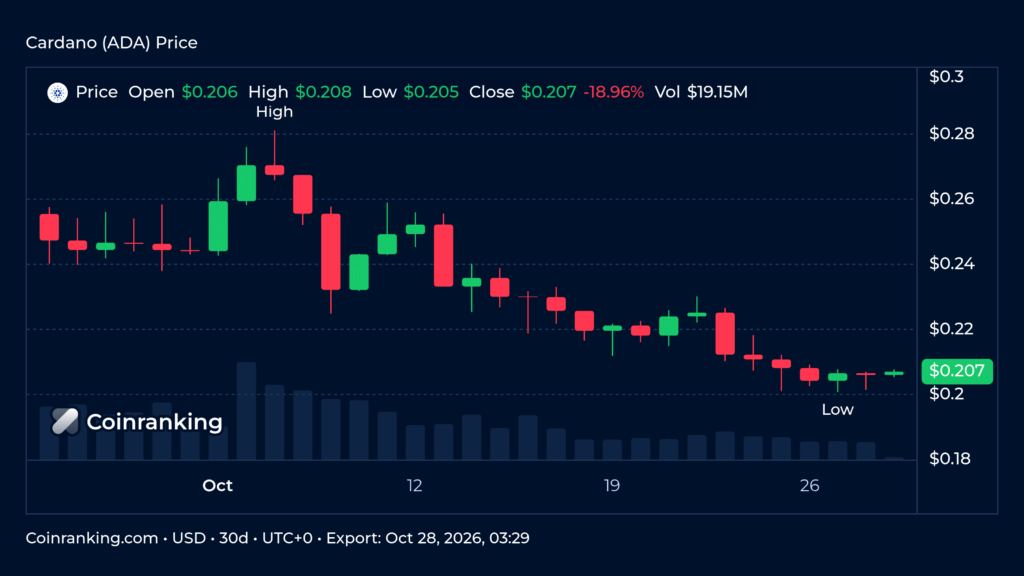
Stake pool operators in the Cardano ecosystem are the first to run the new node on DijkstraNet. The next concrete steps are the node 11.2 prerelease binaries, the hard-fork initiation action and the first protocol version 12 blocks on the test network. Traders can follow ADA through the upgrade on the Cardano price chart. Cardano remains one of the established layer 1 blockchains.
Frequently Asked Questions
When Is the Cardano Node 11.2 Hard Fork?
No date is set. Intersect says the hard-fork initiation action follows the node 11.2 prerelease, and the 11.2.0 tag appeared on GitHub on October 27, 2026.
What Is the Cardano Dijkstra Testnet?
DijkstraNet is the public test network for Cardano protocol version 12. It opened to stake pool operators in October 2026 and still runs Conway protocol version 11 on node 11.1.3.
Does Cardano Node 11.2 Include Leios?
No. Node 11.2 covers the Dijkstra hard fork feature set apart from Leios. Leios is being tested on the separate MusashiNet prototype network.
What Changed for Cardano Mainnet in 2026?
Mainnet moved to protocol version 11 with the van Rossem hard fork on July 18, 2026. The Dijkstra work is on test networks for now.
Sources
- cardano-node 11.2.0 tag on GitHub · IntersectMBO cardano-node
- Upgrade Bulletin #39, October 22, 2026 · Intersect
- Cardano opens Dijkstra testnet as node 11.2 prepares protocol upgrade · crypto.news
Prices and market data: Coinranking.